
Suzzy Williams and the Ghana that was becoming modern
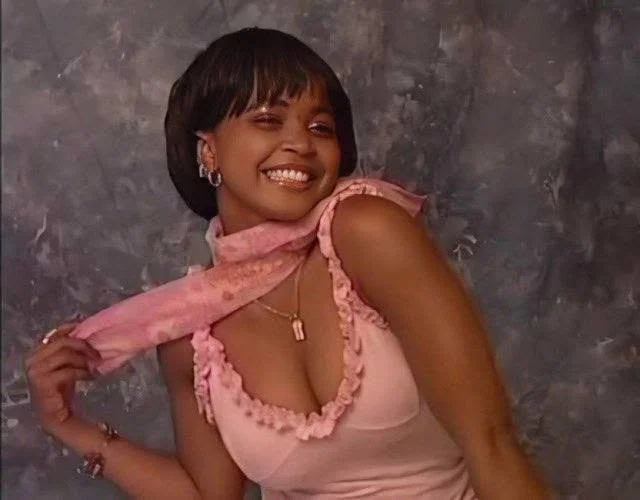
Photograph of Suzzy Williams
V. L. K. Djokoto
Suzzy Williams has been dead for more than twenty years, yet she remains remarkably present in Ghanaian popular memory. Part of this is inevitably because she died at 23, but tragedy alone does not explain why some faces survive while others disappear. Suzzy endures because, for a brief period, she gave Ghanaian cinema a particular kind of star it was ready for: young, glamorous, urban and unmistakably at ease with being seen.
That is the more interesting way to remember her. The motor accident of 8 September 2005 has understandably become inseparable from her name, but death should not be allowed to swallow the work which came before it. To understand Suzzy Williams properly, we have to look again at what she was doing on screen, and at the Ghana which found her so compelling.
In films such as Together Forever, The Comforter, Bloody Mary and Calamity, Suzzy possessed a quality which is easier to recognise than to explain. She had presence. The camera seemed to like her, and she understood how to use beauty, expression, dress and attitude to make a character immediately visible.
She could appear vulnerable without becoming weak, glamorous without seeming completely removed from ordinary Ghanaian life, and difficult without losing the audience’s interest. There was often something restless about her screen persona, a suggestion that the woman she was playing wanted something — love, security, status, independence, recognition — and was prepared to make choices in pursuit of it. In the melodramatic world of early Ghanaian video cinema, where emotions were rarely permitted to remain small, Suzzy knew how to occupy the frame.
This is important because she arrived at a moment when Ghanaian cinema was producing a new image of the young woman. She was no longer simply the dutiful daughter, patient wife or moral counterweight to the troublesome man. She could desire things for herself, make mistakes, dress for attention, argue, leave, return, manipulate, suffer and begin again.
Suzzy was particularly suited to these contradictions. She could play the glamour of modern urban life while retaining enough familiarity for Ghanaian audiences to recognise the social world around her. She did not look like an imported idea of a film star; she looked like a Ghanaian woman who had discovered that Ghana itself could manufacture film stars.
That distinction is central to her cultural importance.
The modernity Suzzy represented was not the abstract modernity of motorways, computers and economic statistics. It was intimate and visible. It appeared in hairstyles, clothes, mobile telephones, romantic choices, speech, ambition and the growing conviction among young people that identity could be constructed rather than simply inherited.
Ghana at the beginning of the 2000s was becoming increasingly comfortable with this kind of self-invention. Private radio had already transformed public conversation, mobile telephones were becoming ordinary possessions, home video had created a mass market for African stories and entertainment journalism was turning actors and musicians into personalities. For a new urban generation, modern life was increasingly something one could perform as well as experience.
Suzzy fitted this moment unusually well.
There was a confidence to her image which made sense in the Accra that was emerging around her. Her hairstyles changed, her clothes mattered and her public photographs carried the self-awareness of someone who understood that an actress was becoming more than the characters she played. She was becoming an image in her own right.
Today this seems entirely normal. Actors maintain carefully constructed social-media identities, fashion houses dress celebrities, brands purchase access to their audiences and personal visibility has become an industry of its own. In Suzzy’s Ghana, this machinery was far less developed, and the Ghanaian celebrity was still being invented.
She was one of the people helping to invent it.
Before Instagram, celebrity travelled through films, radio interviews, newspaper photographs, television appearances, premieres and conversation. A performer could not manufacture national visibility simply by posting often enough; the work still had to carry much of the burden. People had to watch the film, remember the face and want to see that person again.
Suzzy made herself memorable.
This was not simply a matter of physical beauty, although it would be artificial to discuss her stardom while pretending beauty played no part in it. Cinema has always understood the power of the face, and Suzzy possessed one which registered immediately on screen. But Ghana has never suffered a shortage of beautiful women, and beauty alone does not explain cultural memory.
What distinguished Suzzy was the way she combined beauty with character. There was mischief in the face, confidence in the posture and a certain directness in the way she occupied the screen. She could look polished without becoming distant, and there was enough unpredictability in her performances to make even an imperfectly written character interesting.
That quality mattered enormously in the cinema of the period. The Ghanaian video films of the late 1990s and early 2000s were often produced quickly and with limited resources, so performers carried responsibilities which more expensive productions could distribute between cinematography, editing, production design and elaborate direction. A strong actor or actress could give a modest film its energy.
Suzzy had that energy.
There is a temptation, particularly among people who consider themselves culturally sophisticated, to look back at this period with some amusement. The plots could be improbable, the sound uneven and the acting occasionally larger than the rooms in which it took place. Betrayals arrived spectacularly, family secrets emerged with extraordinary regularity and supernatural punishment was never entirely out of the question.
But popular cinema is not made irrelevant by its excesses. Those films were watched because the emotional and social worlds beneath the exaggeration were recognisable. They dealt repeatedly with money, marriage, religion, sex, status, migration, jealousy, family obligation and the struggle to improve one's circumstances.
These were not random themes. They were the anxieties of a society negotiating rapid change.
Suzzy's characters often stood directly inside those negotiations. The young woman on screen could be pulled between respectability and desire, family expectations and personal freedom, romantic love and material security. These tensions gave actresses of her generation a cultural significance which extended beyond the plots themselves.
The clothes matter here too.
Fashion is sometimes treated as the frivolous edge of culture, but it is one of the clearest languages through which social change announces itself. What people choose to wear tells us how they wish to be read, which worlds they admire and what forms of freedom they believe are available to them.
Suzzy understood the visual force of clothes. Her dresses, hair, make-up and poses helped construct an image of youthful Ghanaian glamour which belonged unmistakably to the early 2000s. Look at her photographs today and one does not simply see Suzzy Williams; one sees the texture of an era.
This is why she belongs to Ghana's visual history as much as to its film history.
The early 2000s occupy an interesting cultural position because they sit immediately before the digital transformation of everyday life. There were mobile phones but not smartphones, internet cafés but not permanent connectivity, celebrities but not influencers, and public images which could still retain some distance from private lives. The star remained visible without being permanently available.
Suzzy belonged to perhaps the last generation of Ghanaian celebrities who could possess that kind of mystery. The public knew her face and followed her films, but it did not accompany her from breakfast to bedtime. There were spaces in which she could simply disappear.
That distance helped create stardom. A film star was somebody one waited to see, rather than somebody whose morning routine appeared automatically on a telephone screen. Celebrity depended partly upon scarcity, and scarcity allowed imagination to do some of the work.
The modern celebrity lives under different conditions. Visibility is continuous, personality is monetised and the distinction between private life and professional performance has almost disappeared. We know more about our stars than previous generations could have imagined, although it is not obvious that this greater quantity of information has produced greater intimacy.
Suzzy's image comes from the other side of that divide.
This makes her surviving films and photographs particularly interesting cultural objects. They preserve not merely an actress but a form of Ghanaian celebrity which existed for a relatively brief period between the expansion of private media and the arrival of social media. She became widely known, yet the machinery through which she became known now appears almost ancient.
And then, suddenly, everything stopped.
The tragedy of dying at 23 is not merely that life is short. It is that development becomes impossible, and a person is permanently judged at an age when most lives are still being assembled. Suzzy never had the opportunity to become a more experienced actress, reconsider early choices, change her image, produce films of her own, disappear from cinema or surprise the public by becoming something entirely different.
She remains 23 while everybody else has moved on.
There is something particularly powerful about that arrested ageing in popular culture. The audience which first watched her has grown older, the actors who worked beside her have matured and Ghanaian cinema has undergone several transformations. Suzzy alone remains where history left her.
This can easily turn an artist into mythology.
When someone dies young, the circumstances of death begin gradually to compete with the work. The accident becomes more familiar than the films, stories about the private person replace discussion of the performer and eventually the tragedy threatens to become the principal reason the name is remembered.
We should resist that with Suzzy Williams.
Her significance is not that she died young. Her significance is that before she died young, she had already become recognisable enough for an entire country to feel the interruption. The scale of the mourning was itself evidence of the cultural position she had achieved.
That position deserves to be documented more seriously.
Ghana has not always treated popular culture as something worthy of an archive. Films disappear, television recordings become difficult to find, photographs lose their captions, newspapers deteriorate and people who witnessed important periods of our cultural life die without their memories being recorded. We preserve the official history of the nation rather better than we preserve the ordinary culture through which people actually experienced it.
This is a mistake.
A VHS cassette containing a Ghanaian film from 2001 is an historical object. So is a film poster, an entertainment newspaper, a studio portrait, an old radio interview or a photograph from a premiere. These objects tell us what people wore, what they desired, what made them laugh and what they thought success looked like.
Suzzy's work deserves this kind of preservation. Her films should be properly catalogued and, where necessary, restored and digitised, while interviews, photographs and press material should be gathered rather than allowed to disappear into private collections and deteriorating archives. The people who worked with her should also be recorded while their memories remain available.
This is not nostalgia. It is cultural housekeeping.
There is another issue which becomes unavoidable when considering Suzzy’s legacy, and that is the way we remember women in public life. Female celebrities are frequently reduced to beauty, relationships, clothes and rumours with an enthusiasm rarely applied in quite the same way to their male colleagues. When the woman dies young, the problem becomes worse because she never acquires the authority of age with which to revise the public's understanding of her.
Suzzy cannot tell us what she thought of the roles she played at 21. She cannot laugh at an old photograph, reject an old interview or explain that a story repeated for twenty years was nonsense. She cannot grow beyond the version of herself which Ghana happened to know.
We therefore owe her memory some restraint.
Had she lived, Suzzy Williams would now be in her forties, and it is tempting to imagine what she might have become. Perhaps she would have become one of the senior women of Ghanaian cinema, perhaps she would have moved into production or business, and perhaps she would simply have walked away from public life. None of us knows.
The more useful question is what she actually left behind.
She left a body of films which belongs to a formative period of Ghanaian popular cinema. She left an image which became part of the country’s vocabulary of glamour, and she helped establish the idea that a young Ghanaian actress could become a genuine popular celebrity. Most importantly, she gave the Ghanaian screen a kind of young woman whom audiences recognised as belonging to the changing world around them.
That is where the modernity argument becomes real.
Modernity is not simply the arrival of something foreign or technological. It is the process through which people renegotiate the terms on which they live, love, work, dress and imagine themselves. Suzzy’s characters existed in precisely that unsettled territory.
The women she played wanted things.
That simple fact is important. They wanted love, comfort, independence, recognition and sometimes money; they made choices in pursuit of those desires and sometimes paid heavily for them. Whatever the quality of the individual scripts, this was a significant image to place repeatedly before a mass Ghanaian audience at the beginning of a new century.
Suzzy made those women visible.
A nation is not made only in Parliament, at Independence Square or through the speeches of presidents. It is also made in cinemas and recording studios, in fashion and slang, in popular photographs and in the faces ordinary people choose to remember. Culture tells us what official history frequently cannot: how it felt to be alive at a particular moment.
Suzzy Williams became one of the faces through which Ghana experienced the beginning of the twenty-first century. She was young in a country becoming younger in its cultural outlook, glamorous at a moment when Ghanaian popular culture was becoming more visually confident, and famous when Ghana was learning how to manufacture a new kind of home-grown celebrity.
Her death froze that image. It should not define it.
More than twenty years later, the better tribute is therefore not simply to mourn the actress who never grew old. It is to watch the work again, recover the world around it and recognise Suzzy Williams for what she had already become before tragedy intervened: not merely a beautiful young woman on Ghanaian screens, but one of the figures through whom a changing Ghana began to picture itself.