
Okaidja Afroso and the art of carrying home

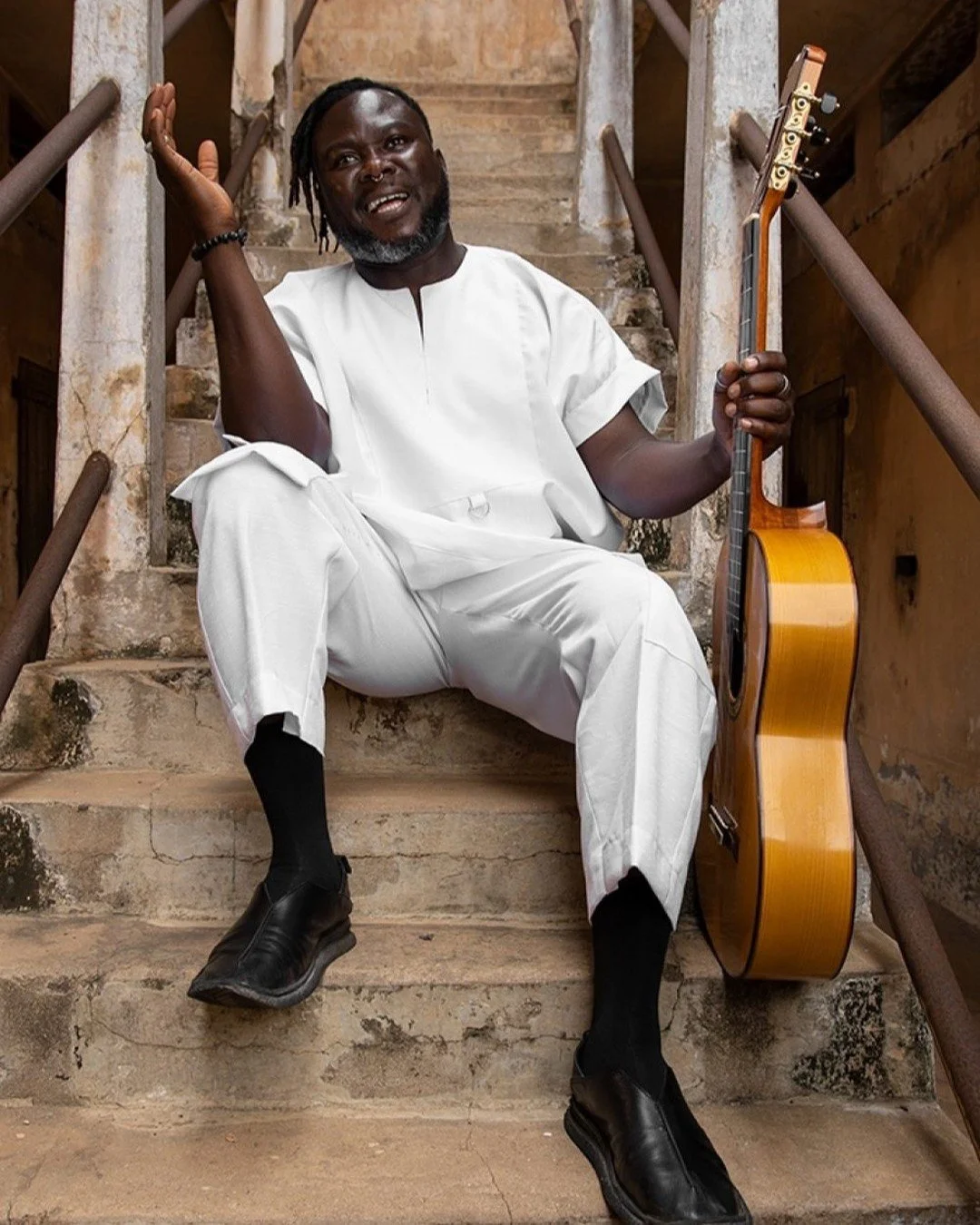
Okaidja Afroso makes music which has travelled, but never sounds homeless. There is Ghana in the percussion, in the movement of his voice and in the rhythmic intelligence beneath his compositions, even when the music moves beyond the familiar categories through which Ghanaian sound is usually understood. His work offers a compelling argument about contemporary African culture: we do not have to abandon tradition in order to become modern, because tradition itself can provide the material from which an African modernity is built.
This is the central importance of Afroso’s work. His career as a musician, dancer, percussionist and composer demonstrates that cultural inheritance need not function as an anchor holding the artist to the past; properly understood, it can become the means by which the artist moves confidently into the future. What emerges from his work is therefore neither a reconstruction of an untouched African past nor an abandonment of tradition in pursuit of international accessibility, but a continuing process in which inherited forms are used to create something contemporary.
That distinction deserves attention because African modernity is still too often imagined as a journey away from the local. The modern city replaces the village, English displaces the indigenous language, electronic production replaces the traditional instrument and international recognition becomes evidence that an artist has finally escaped the limitations of place. Beneath these assumptions lies the mistaken idea that tradition belongs to yesterday while modernity must necessarily arrive from somewhere else.
Afroso complicates this distinction. His work suggests that the real question is not whether an artist chooses between tradition and modernity, but what he is capable of making from the relationship between them. Tradition, in this understanding, is not simply something inherited; it is something worked upon.
For Afroso, that work begins with rhythm. Before considering him simply as a singer-songwriter, it is important to recognise that his artistic formation developed through dance and percussion, disciplines in which music is understood not only through sound but through the body. A dancer encounters rhythm physically, while a percussionist learns that rhythm is not merely the background against which melody occurs but a language capable of organising the entire musical experience.
This bodily understanding remains important to Afroso’s music. His compositions can be melodic and contemplative, but beneath them there is frequently a rhythmic architecture which prevents the music from becoming merely decorative. Guitar and voice may carry the immediate song, but percussion supplies much of its memory and internal movement.
This is significant within the broader history of Ghanaian musical traditions, where rhythm has rarely functioned simply as accompaniment. Drumming can summon communities, accompany ceremony, communicate social information, mark grief and create the conditions for collective celebration. Dance, similarly, can contain histories of gender, occupation, authority, spirituality and communal identity which cannot always be adequately translated into written language.
Music and dance in such contexts become forms of knowledge. The musician is not simply entertaining an audience, and the dancer is not merely decorating a musical performance; both may participate in the transmission of social memory. Afroso's development through these traditions gave him an artistic vocabulary in which sound, movement and memory were never entirely separate.
This is where his work begins to challenge conventional ideas of modernity. If knowledge can exist within rhythm, movement and performance, then the traditional arts are not merely remnants of an earlier society waiting to be preserved. They are intellectual resources which contemporary artists can continue to use.
The distinction between preservation and production is crucial. A culture which merely preserves its traditions may succeed in keeping objects, recordings and ceremonies intact while allowing the creative intelligence behind them to disappear. A living culture does something more difficult: it allows each generation to use inherited knowledge for purposes which previous generations could not have anticipated.
Afroso belongs to this second tradition. His work does not treat Ghanaian culture as an exhibition which must remain untouched; it treats inheritance as a vocabulary. A vocabulary survives not because the same sentences are repeated forever, but because people continue using familiar words to say new things.
This principle becomes particularly useful when considering the limitations of genre. Contemporary music industries depend heavily upon categories such as Afrobeats, highlife, Afro-fusion, folk, jazz and the increasingly inadequate term "world music", partly because audiences and commercial platforms require some indication of what they are about to hear. Yet these categories can become restrictive when applied to musicians whose work emerges from several traditions at once.
Afroso is such a musician. Labels may describe elements of his sound, but they cannot fully explain the cultural process beneath it, because his music is better understood as an accumulation of experiences rather than membership of a single genre. Ghanaian traditions, dance, migration, collaboration and musical encounter are allowed to coexist without one entirely displacing another.
This is also why migration matters to understanding his work. Migration is usually discussed in Ghana through economic categories, as people leave in pursuit of education, employment, security and opportunity while national conversation concentrates on remittances, brain drain and the difficulties of life abroad. Yet migration is also a producer of culture because movement changes the relationship between people and the places from which they come.
Distance can make ordinary things newly visible. Food becomes memory, language becomes intimacy and music can become a means of reconstructing a place which is no longer physically available. The migrant therefore does not simply move between territories; he also begins the more complicated work of comparing cultural worlds.
Diasporic artists occupy this tension particularly clearly. They carry an inherited cultural vocabulary while acquiring another through experience, and their work becomes a space in which these different forms of knowledge are negotiated. At its weakest, this can descend into nostalgia; at its strongest, distance allows inheritance to be examined, rearranged and made productive again.
Afroso's music occupies this productive middle ground. Ghana does not survive in the work merely as a memory of somewhere left behind, because inherited forms continue to participate actively in the construction of the new music. Home becomes method rather than souvenir.
The African artist working internationally is frequently expected to perform one of two identities. He can become sufficiently cosmopolitan that his origins become incidental, or he can perform an easily recognisable version of “African authenticity” for audiences seeking cultural difference. Neither position is particularly satisfying because both allow the expectations of the external audience to determine the terms on which African identity appears.
Afroso suggests a third position. The artist can be culturally specific without becoming culturally static, and cosmopolitan without becoming culturally anonymous. He can enter the world from somewhere rather than believing that internationalism requires him to come from nowhere.
This is a useful way to reconsider the relationship between Ghana and global culture more broadly. We often speak of international recognition as though the important part of the story is that somebody elsewhere has finally noticed us. A musician performs successfully in Europe or North America and is said to have “gone international”, as though Africa stands outside the international world until recognition is conferred from another centre.
African modernity need not be understood as successful imitation of somebody else’s present. Accra, Dakar, Lagos, London and New York all participate in modernity, even if they occupy unequal positions within the global economy and cultural system. The more interesting question is what each place contributes to the modern world from the resources of its own history.
This is where the Ga cultural environment associated with Afroso’s formation becomes particularly interesting. Accra has become so dominant as the political, economic and media centre of Ghana that the city is often imagined principally as a national capital rather than as a place with an older cultural geography. Beneath the ministries, motorways, estates, shopping centres and expanding metropolitan population lies a Ga cultural landscape whose relationship with the modern city deserves greater attention.
Accra’s cosmopolitanism did not begin with airports, international corporations or contemporary migration. Coastal communities had encountered trade, migration, European commercial interests and other African societies for centuries, producing forms of cultural exchange long before the language of globalisation existed. The modern cosmopolitan city therefore sits upon older histories of movement and encounter.
This history further weakens the supposed opposition between tradition and cosmopolitanism. The cosmopolitan person is often imagined as belonging to the world, while the traditional person belongs to a particular place, yet Ghanaian coastal history suggests that belonging strongly to a place has never prevented that place from encountering others. Tradition itself can contain histories of movement.
This matters enormously for the way we understand authenticity. Cultural authenticity cannot sensibly mean freedom from external influence, because cultures have always changed through trade, migration, conquest, marriage, technology and curiosity. What makes a cultural form distinctive is not that nobody else has touched it, but that a community has acquired the authority to make influences its own.
Highlife provides perhaps the clearest Ghanaian example. Ghanaian musicians encountered guitars, brass instruments, jazz, maritime musical cultures and other foreign forms, but they did not simply reproduce European music in West Africa. They absorbed what was useful, altered it through local musical intelligence and eventually produced forms which became part of Ghana's own inheritance.
What we now call tradition was once innovation. Languages borrow words, cooks adopt ingredients, musicians encounter instruments and cities absorb architecture, because living cultures have always changed through contact. A culture demonstrates confidence not by avoiding influence, but by transforming it.
Afroso’s work belongs within this longer history of adaptation. His cosmopolitanism is not a rejection of Ghanaian tradition but one of the things that tradition makes possible. Because there is a strong cultural centre, encounter becomes less threatening.
This argument has particular relevance at a moment when African popular music enjoys unprecedented international visibility. The global success of Afrobeats and related forms has opened commercial and cultural spaces which earlier generations of African musicians often struggled to enter, while digital distribution has reduced many of the old barriers separating African artists from international audiences. This development deserves celebration, but every successful cultural form also creates pressure towards imitation.
Once an international market recognises a profitable African sound, musicians, producers and record companies naturally respond. Production begins to converge, vocal styles become familiar and artists emerging from societies with very different musical histories can find themselves operating within an increasingly narrow sonic vocabulary. The danger is not international success; it is cultural interchangeability.
Ghana should be particularly attentive to this problem because our musical strength has never depended upon a single sound. Even highlife contains different histories and regional practices, while beneath national categories lies a much greater diversity of musical cultures associated with different languages, communities, occupations and historical experiences. The sounds of northern Ghana need not resemble those of the coast, just as the musical traditions of the Volta basin need not be absorbed into a generic conception of African music.
Difference is cultural capital.

This is where cultural policy becomes important. Ghana has traditionally approached indigenous culture principally through the language of preservation: festivals are supported, traditional performances are presented at national occasions, cultural centres exist and heritage is celebrated rhetorically as part of national identity. Preservation is necessary, but preservation by itself is not a cultural development strategy.
The policy objective should be more ambitious. Ghana should treat indigenous cultural knowledge as productive infrastructure for the creative economy.
This would require a change in the way the state thinks about culture. A traditional rhythm should not matter only because it is old; it should also matter because a young producer might build tomorrow’s music from it. A traditional dance should not survive merely for display at a festival; it should be documented, taught and made available as a serious body of knowledge from which dancers, choreographers, filmmakers and theatre practitioners can create new work.
The same principle applies to language. Ghanaian languages should not appear in cultural policy only as heritage requiring protection, because they are also creative assets capable of generating literature, cinema, theatre, music, animation, broadcasting and digital content. A language which exists only in ceremonial speeches is being preserved; a language in which young people can build careers is being sustained.
This requires investment in transmission.
Ghana needs serious programmes for documenting musical traditions, instruments, dances, oral histories and performance practices while the practitioners who possess this knowledge are still alive. Such archives should not simply sit in institutions in Accra, accessible mainly to academics. They should be digitised, searchable and available to musicians, students, filmmakers, choreographers, designers and other creative practitioners who can make new work from them.
The distinction is important because an archive should not become a cemetery.
If Ghana spends money recording an elderly master drummer but creates no system through which a 19-year-old percussionist can study that material, the state has preserved evidence of a tradition while failing to preserve the tradition itself. Documentation must therefore be connected to apprenticeship, education and production.
Cultural education should form the second part of such a policy. Music and dance traditions should be treated with the same seriousness accorded to other forms of knowledge, and institutions responsible for arts education should create structured opportunities for young practitioners to learn directly from recognised traditional artists. The master practitioner should be understood not merely as a performer invited for ceremonial occasions but as a bearer of specialised knowledge worthy of institutional recognition and remuneration.
The third requirement is production. Public support for culture should not stop at teaching inherited forms; it should help artists turn those forms into new work. Competitive grants, residencies, recording facilities, commissions and collaborations could enable musicians, dancers, composers, filmmakers and digital artists to experiment with Ghanaian cultural materials without requiring the final product to resemble a museum performance.
This is where Afroso becomes particularly instructive. His value does not lie in reproducing tradition exactly as he received it, but in demonstrating what can happen when an artist possesses enough knowledge of inherited forms to transform them intelligently. Ghanaian cultural policy should aim to produce the conditions in which hundreds of artists can undertake similar experiments from entirely different cultural traditions.
The fourth requirement is commercialisation. Ghana cannot seriously speak about a creative economy while treating the economic exploitation of indigenous cultural knowledge as an afterthought. Research, documentation and training should ultimately connect to publishing, touring, film, gaming, fashion, recorded music, licensing, tourism and other industries capable of generating employment and intellectual property.
This is not an argument for turning every cultural practice into a commodity. Some traditions possess sacred, communal or restricted meanings which should not be commercially exploited, and the communities which hold them must retain authority over their appropriate use. Cultural policy must therefore combine economic ambition with ethical rules concerning ownership, consent, attribution and benefit.
But where commercial use is appropriate, Ghana should be capable of capturing more of the value generated by its own cultural resources. The creative economy cannot consist merely of exporting talented individuals after they have struggled privately to acquire knowledge which public institutions failed to support. A functioning cultural system should connect inheritance to education, education to production, production to intellectual property and intellectual property to income.
This is the missing chain.
At present, discussions about Ghana's creative economy often begin near the end of that chain. We speak about international festivals, streaming numbers, export potential, copyright revenues and global recognition, all of which matter, but these are outputs. The deeper policy question concerns the cultural inputs from which distinctive Ghanaian work will continue to be produced twenty or fifty years from now.
If those inputs weaken, commercial success becomes increasingly dependent upon imitation.
Ghana therefore needs to think of cultural infrastructure as something broader than theatres, museums and performance venues. Infrastructure also includes knowledge: the drummer who knows a repertoire which has never been properly recorded, the dancer who understands movements no textbook explains, the instrument maker whose craft has no apprentice and the oral historian carrying material which exists nowhere else. When such people die without transmitting what they know, Ghana loses productive cultural capital.
This is not simply a cultural loss. It is an economic one.
Countries which successfully export culture rarely begin with exports. They invest over long periods in the institutions, education, archives and domestic markets which allow creative communities to become productive. International success is then built upon a cultural ecosystem rather than a succession of exceptional individuals.
Ghana has no shortage of exceptional individuals. What remains less developed is the system around them.
A sharper cultural policy would therefore stop asking only how government can “support the arts” and begin asking how Ghana can build an economy from the extraordinary diversity of knowledge already present within the country. The first formulation encourages occasional interventions; the second requires institutions.
That distinction matters.
If success is measured only by international commercial visibility, Ghana can pursue whichever sound currently performs best in global markets. If the objective is a durable cultural economy, however, then languages, instruments, dance traditions, archives, local histories and systems of artistic education must be understood as productive assets rather than decorative reminders of the past.
Afroso represents the possibilities of such an approach. His career suggests that rootedness can increase artistic mobility rather than restrict it, because the more securely an artist understands the materials from which he works, the more freely he can encounter other traditions without fearing that every influence will displace what came before. Cultural confidence provides an anchor precisely because the artist intends to move.
This does not mean every Ghanaian musician should play a traditional instrument, sing in a Ghanaian language or make explicit reference to inherited forms. Such prescriptions would merely replace one commercial formula with a cultural one, and genuine creativity cannot survive if artists are required to perform authenticity. Cultural confidence is an intellectual position, not an aesthetic uniform.
It is the ability to encounter the world without assuming that everything valuable originates elsewhere. It permits borrowing without disappearance, experimentation without apology and the recognition that something created from a highly particular place can possess meaning beyond it. The local and the universal need not be adversaries.
Okaidja Afroso’s artistic journey makes this argument tangible. His work has moved through dance, percussion, songwriting, migration and international collaboration, yet these experiences accumulate rather than simply replacing one another. The traveller changes, as travellers inevitably do, but the journey does not erase the point of departure.
Perhaps this is a more useful way to understand what it means for Ghanaian culture to become global. Globalisation should not require every culture to resemble every other culture; its more interesting possibility is that movement and technology allow highly particular forms of human expression to circulate far beyond the places which produced them. The local can travel without ceasing to be local.
Afroso’s work has spent years demonstrating that possibility. It reminds us that home need not be understood only as the physical place in which an artist lives, because it can survive in rhythm, language, bodily memory, musical structure and the habits of listening acquired long before migration begins. A person may cross oceans and still create from somewhere.
For Ghana, the lesson is larger than one musician. The country should want its artists to travel, collaborate, experiment and enter cultural spaces which previous generations could not easily reach, because a culture which refuses encounter eventually turns inward upon itself. But Ghana should equally build the institutions which ensure that when its artists enter the world, they have a deep and accessible cultural inheritance from which to draw.
Okaidja Afroso demonstrates that tradition need not stand behind us as a monument to a disappearing past. It can stand beside us as productive knowledge: capable of being taught, studied, reinterpreted, financed and transformed into new cultural work. Ghanaian policy should therefore concern itself not merely with preserving what previous generations created, but with ensuring that inherited knowledge becomes raw material for what the next generation has yet to imagine.
That is not simply cultural preservation.
It is cultural development.