
Artist Kɔsi Gobah: Memory, Material and the Making of a Ghanaian Artist
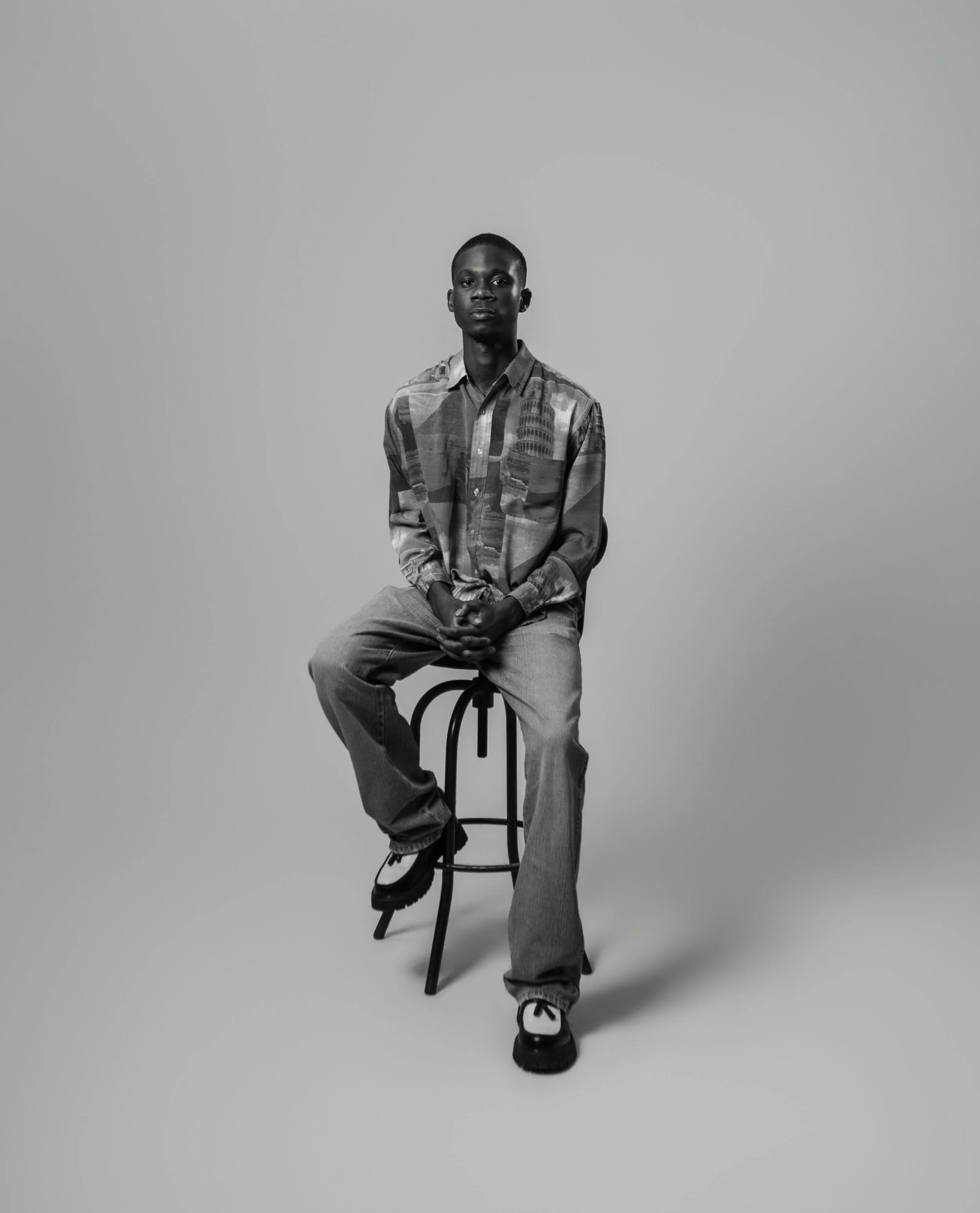
V. L. K. Djokoto
One of Kɔsi Gobah’s earliest memories is of sand. As a child in Anloga, he remembers struggling to walk through it, his small feet negotiating a landscape that belonged to the older history of his family. It is an ordinary childhood memory, but it provides an interesting entrance into the life of an artist whose work has increasingly concerned itself with memory, inheritance and the uncertain relationship between what happened and what is remembered.
Gobah was born in 2002 and grew up principally in Dansoman, Accra. His childhood was urban, comfortable and expressive, and he describes himself during those years as a spoilt child. He attended nursery at God’s Home Academy, where he acted, sang and became a popular pupil, suggesting that creative expression entered his life through performance before it acquired the more permanent form of visual art.
There were two important domestic spaces in his childhood, both in Dansoman. The first was his family house, while the second was another house in the area, but it was the family house that he preferred because of the warmth he associated with it. The distinction is culturally important because the Ghanaian family house is rarely only residential space; it is also a social institution through which kinship, memory and obligation are continuously reproduced.
His was a family that celebrated milestones. Graduations, promotions, marriages and other moments of advancement became occasions for parties and collective recognition, and because many of Gobah’s older cousins were considerably older than him, there was usually some new milestone to observe. He remembers, among these occasions, Edem getting married, one of those seemingly ordinary family memories through which a child gradually learns the ceremonies and expectations of adulthood.
These gatherings formed part of a wider cultural inheritance. Gobah comes from a deeply rooted Ewe family associated with Kete, or Kente, a textile tradition in which colour, pattern, technique and social meaning are joined together. The family’s involvement in cloth is particularly relevant to Gobah because his later interests would move between painting, clothing, fashion photography and creative direction.
This relationship should not be reduced to the convenient argument that an ancestor wove cloth and a descendant became an artist. What is more interesting is the continuity of the surface as a place of cultural communication. Cloth and canvas are different objects with different histories, but both can become surfaces upon which a society organises colour, identity, memory and meaning.
Dansoman provided the immediate landscape of Gobah’s childhood. He attended schools in and around the area and developed a particular preference for St. Martin de Porres School when his parents were considering where he should continue his education. His choice brought him into a competitive academic environment, and he recalls his class teacher announcing to his new classmates that a competitive student had arrived.
Competition consequently appears early in his recollection of school. Yet the names of many childhood friends have disappeared from memory, something Gobah explains simply as “out of sight, out of mind”. The remark is casual, but it illustrates one of the contradictions of remembering: whole periods of life may disappear while apparently insignificant images remain unusually clear.
The bicycle remains one of those images. Gobah remembers allowing somebody in the neighbourhood to take his bicycle because he assumed it would be returned, only to discover that it had effectively been stolen. The story survives alongside the sand of Anloga, the family parties and the schoolroom competition, producing the uneven collection of details from which childhood is later reconstructed.
Memory works in precisely this way. It does not preserve the past evenly, and it does not necessarily distinguish between the historically important and the personally vivid. A marriage, a stolen bicycle, a teacher’s remark and the physical difficulty of walking through sand can survive beside one another long after countless other experiences have disappeared.
This problem of selection would eventually become relevant to Gobah’s visual practice. His paintings repeatedly encounter figures and moments that have already passed through photography, newspapers, entertainment culture or public memory. He is therefore often working not simply with events, but with representations of events.
Before he settled on art, however, Gobah imagined another profession. Growing up, he told his father that he wanted to become a journalist, an ambition made more interesting by his early relationship with Graphic Communications. He drew cartoons for the Daily Graphic and Junior Graphic, placing the visual image and the newspaper together at an early stage in his development.
By Class Six, the direction had changed. During a career day, Gobah decided that he wanted to become an artist. Journalism and visual art nevertheless share a basic cultural function, because both are concerned with deciding what should be shown, what should be excluded and how an event, personality or idea should be framed.
This connection is particularly useful in reading Gobah because the archive, the photograph and the public personality later become recurring elements in his work. A newspaper does not reproduce reality in its entirety; it selects a photograph, writes a headline and constructs an account. A painting based upon an archival photograph performs another act of selection, moving the image from one context of meaning into another.
Gobah’s visual ability eventually took him to Adisadel College on a scholarship from Graphic Communications. His father placed considerable hope in his artistic ability, while the influence of his visual arts teacher, Obiri-Obeng, also became important. An Adisadel old boy himself, Obiri-Obeng combined strictness with a degree of creative freedom and helped make the school attractive to the young artist.
At Adisadel, Gobah continued to distinguish himself as a visual arts student. The school introduced another layer into his formation, moving him beyond the immediate geography of Dansoman and into the traditions of one of Ghana’s old secondary institutions. He later enrolled at the Kwame Nkrumah University of Science and Technology to study art, placing his informal creative interests within a more formal artistic education.
Yet painting was only one part of what was developing. Gobah began designing clothes, directing fashion shoots and producing artworks, moving comfortably between disciplines that older systems of artistic classification often keep apart. His creative life consequently developed less as a single professional category than as a network of related visual practices.
This is characteristic of an important shift in contemporary African cultural production. The painter, designer, photographer, stylist and creative director increasingly inhabit overlapping worlds, particularly among a generation formed by digital media. Images circulate between canvas, clothing, photography, advertising and social media with a speed that makes the old divisions between cultural disciplines increasingly difficult to maintain.
In Gobah’s case, however, this contemporary fluidity sits beside the older history of cloth within his family. Fashion is therefore both modern and inherited, even if the meanings of the two traditions are not identical. The cultural interest lies precisely in that coexistence: an old textile economy and a contemporary visual economy meeting within the biography of one artist.
His painting similarly brings different periods of Ghanaian culture into conversation. Gobah has developed a visual language in which black, white and gold recur prominently, while archival and popular images are frequently reconsidered through painting. The resulting works often sit somewhere between portraiture, cultural documentation and the reconstruction of memory.
Black-and-white imagery carries its own historical associations. It belongs to the newspaper archive, the family album, colonial photography, early post-independence documentation and the visual record through which much of twentieth-century Ghana is now encountered. When such imagery is translated into painting, the apparent certainty of the photograph becomes less stable because the artist has already selected, altered and recontextualised it.
Highlife (2026) is an important example. The work takes Kwame Nkrumah as its subject, but it does not depend upon the familiar visual language of the statesman at a podium, the independence leader addressing a crowd or the monumental figure reproduced in political iconography. Instead, Nkrumah appears through the social world, allowing a historical personality to return as a human figure within cultural memory.
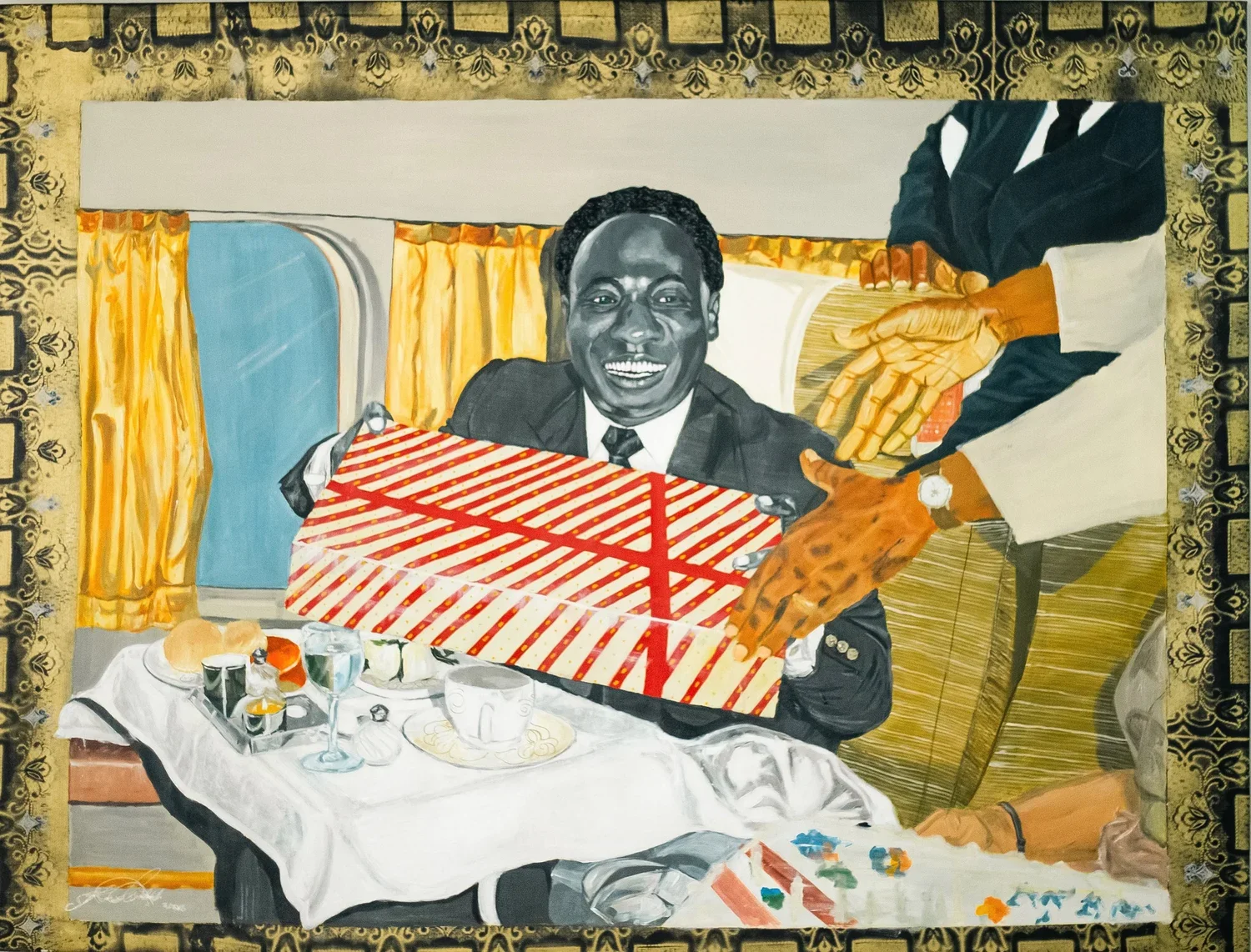
Title: Highlife.
Artist: Kɔsi Gobah (b. 2002)
Date: 2026.
Medium: Acrylic and spray paint on canvas.
Dimensions: 98 x 133 cm.
The title itself expands the meaning of the work. Highlife is not simply a musical genre; it is part of the social history of modern Ghana, carrying associations with urbanisation, leisure, nightlife, fashion, aspiration and the cultural confidence of the twentieth century. By placing Nkrumah within that conceptual field, Gobah brings political history into contact with social history.
This is a recurring feature of his emerging body of work. Official history does not stand alone, separated from music, fashion, entertainment and everyday experience. Political figures, musicians, actors and ordinary social spaces can all become part of the same visual archive because they collectively shape how a society remembers itself.
Coins and Consequences (2025) demonstrates the point from another direction. The trotro, one of the most ordinary features of Ghanaian urban life, becomes a subject worthy of sustained visual attention, while acrylic, newspaper and coffee contribute to the material construction of the work. Here, cultural memory is not located in the presidential archive but in public transport, movement and the everyday economics of the city.
The trotro is particularly rich as a Ghanaian cultural object. It is transport, commerce, language, music, religion, graphic design and social encounter compressed into a moving vehicle. Its presence in visual art therefore raises the ordinary object into the realm of cultural evidence without requiring that the object cease to be ordinary.
Gobah’s interest in popular personalities produces another dimension of this archive. 90s Bad Gyal (2025) engages the memory of Ebony Reigns, while Shooting Star (2025) turns towards Suzzy Williams. These are figures from Ghanaian popular culture whose public images were constructed through music, cinema, photography, newspapers and television before being interrupted by early death.
Their appearance in painting is significant because popular culture has historically occupied an uncertain position within Ghanaian ideas of heritage. States preserve monuments and official documents, while families preserve photographs and oral histories, but the material culture of entertainment is often allowed to disappear. Posters fade, magazines are discarded, television recordings are lost and buildings associated with cultural life are altered without documentation.
The result is a peculiar imbalance in the Ghanaian archive. We know a considerable amount about governments, coups, constitutions and elections, yet the texture of ordinary cultural life can be much more difficult to reconstruct. The clothes people wore, the music played at parties, the advertisements on city walls and the faces that dominated entertainment pages are equally part of the history of a society.
Gobah’s work occupies this broader field of memory. Nkrumah, Ebony Reigns and Suzzy Williams belong to radically different categories of public life, but they all exist within Ghana’s visual memory. The trotro belongs there too, because collective identity is produced as much through ordinary objects and popular personalities as through formal political institutions.
This makes Gobah’s background in newspapers particularly interesting. The newspaper is one of the institutions through which societies decide, every day, what deserves to become part of the record. Yesterday’s newspaper subsequently becomes tomorrow’s archive, transforming the temporary into historical evidence.
The same transformation occurs within painting, although at a different pace. A fleeting photograph can become a permanent painted object, while a popular personality can move from entertainment culture into the gallery. Gobah’s practice therefore participates in the movement of images between different levels of cultural permanence.
His relationship with Ka xoxowo Salon extends this interest beyond the production of individual works. Gobah serves as Art Director of the Salon and held his first solo exhibition there, placing him simultaneously within artistic production and the organisation of an artistic environment. He has also participated in a group exhibition at Ghana’s National Museum, situating his work within both independent and institutional exhibition spaces.
The distinction is important because contemporary African art is shaped not only by the people who produce objects but by the institutions that determine how those objects circulate. Galleries, salons, museums, collectors, newspapers, catalogues and digital platforms all participate in constructing artistic value. The artist is therefore located within a cultural system rather than standing outside society as an isolated creative personality.
Gobah’s position inside this system is still relatively early. Born in 2002, his biography belongs to a generation for whom the cultural institutions of twentieth-century Ghana exist alongside Instagram, digital photography, global fashion and a rapidly expanding international market for contemporary African art. His visual vocabulary emerges from this mixture rather than from a single artistic tradition.
That mixture is also visible geographically. There is Dansoman, the urban Accra neighbourhood in which much of his childhood unfolded, and there is Anloga, connected to family history and the cultural landscape of the Volta Region. There is Cape Coast through Adisadel, Kumasi through KNUST, and Accra again through the contemporary art and fashion worlds in which he now operates.
These places do not simply form a sequence on a biography. Each represents a different cultural environment and therefore a different way of seeing. The family house, the secondary school, the university studio, the fashion shoot, the museum and the independent salon each organise visual culture according to different rules.
The importance of Gobah’s family background consequently lies less in providing an attractive origin story than in establishing the depth of the cultural material surrounding his practice. Kete belongs to a system in which visual design, labour, family enterprise and social meaning are connected. Contemporary painting belongs to another system, but Gobah’s biography places the two close enough for the relationship to become intellectually productive.
His childhood ambition to become a journalist provides another connection. Journalism deals in the immediate present, while painting has historically been associated with permanence. Gobah’s work increasingly occupies the space between them, taking images and personalities from public circulation and returning them as objects for slower consideration.
There is also an important generational dimension to this process. Gobah was born after many of the cultural figures and historical moments that appear within the visual archive he engages. His relationship with them is therefore mediated by photographs, newspapers, stories, recordings and inherited memory rather than direct experience.
This is what makes the practice culturally interesting. Memory is being handled by somebody who did not necessarily experience the original moment being remembered. The past consequently becomes material available for reinterpretation by a generation that inherited its images but not its experiences.
In this sense, Gobah belongs to a wider generation of young Ghanaian cultural producers confronting an enormous archive of unfinished histories. Independence, Nkrumahism, military rule, Highlife, Hiplife, old cinema, fashion, migration and the rapid transformation of Accra all survive in fragments. Some fragments exist in institutions, others in family homes, and many survive principally in photographs circulating online.
The contemporary artist becomes one of the people capable of reorganising these fragments. The process is not history in the academic sense, because the artist is not obliged to establish the factual record with the methods of the historian. Art instead reveals how history feels after it has entered memory.
This distinction helps explain why Gobah’s earliest recollections matter. The sand at Anloga is not important because it represents a great historical event, and the stolen bicycle is not important because it changed Ghanaian society. They matter because culture is ultimately experienced through precisely such intimate encounters between the individual and his surroundings.
The same principle applies to national memory. Ghana is not experienced only through Independence Square, Parliament House or the speeches of presidents. It is experienced through family parties, school competitions, newspapers, trotros, music, clothing, neighbourhoods, celebrities and the countless objects that surround ordinary life.
Gobah’s emerging body of work places these different registers within the same cultural field. The statesman and the musician, the actress and the trotro, the newspaper image and the painted canvas cease to belong to completely separate categories. Together, they become fragments of the visual language through which Ghana has imagined itself.
This is ultimately what makes Kɔsi Gobah an interesting subject at this stage of his career. His biography contains several of the tensions shaping contemporary Ghanaian culture: inheritance and modernity, local memory and global circulation, painting and fashion, analogue archives and digital images, family tradition and individual authorship. None of these tensions requires a final resolution for them to be culturally significant.
The boy who once struggled through the sand at Anloga now works within an artistic world stretching across painting, clothing, photography, exhibitions and cultural direction. Behind that world sits the older history of family, textile and Ewe cultural life; around it sits the fast-moving visual culture of contemporary Accra. Between the two is an artist born in 2002, looking backwards at histories he inherited while working within a cultural present that is still being made.
Perhaps the most revealing thing about Gobah, then, is not any single painting. It is the collection of cultural worlds that meet within his practice and biography. Kɔsi Gobah provides a useful portrait of what it means to become a Ghanaian artist in the twenty-first century: to inherit the archive, inhabit the present, and discover that the distance between the two is often much smaller than it first appears.
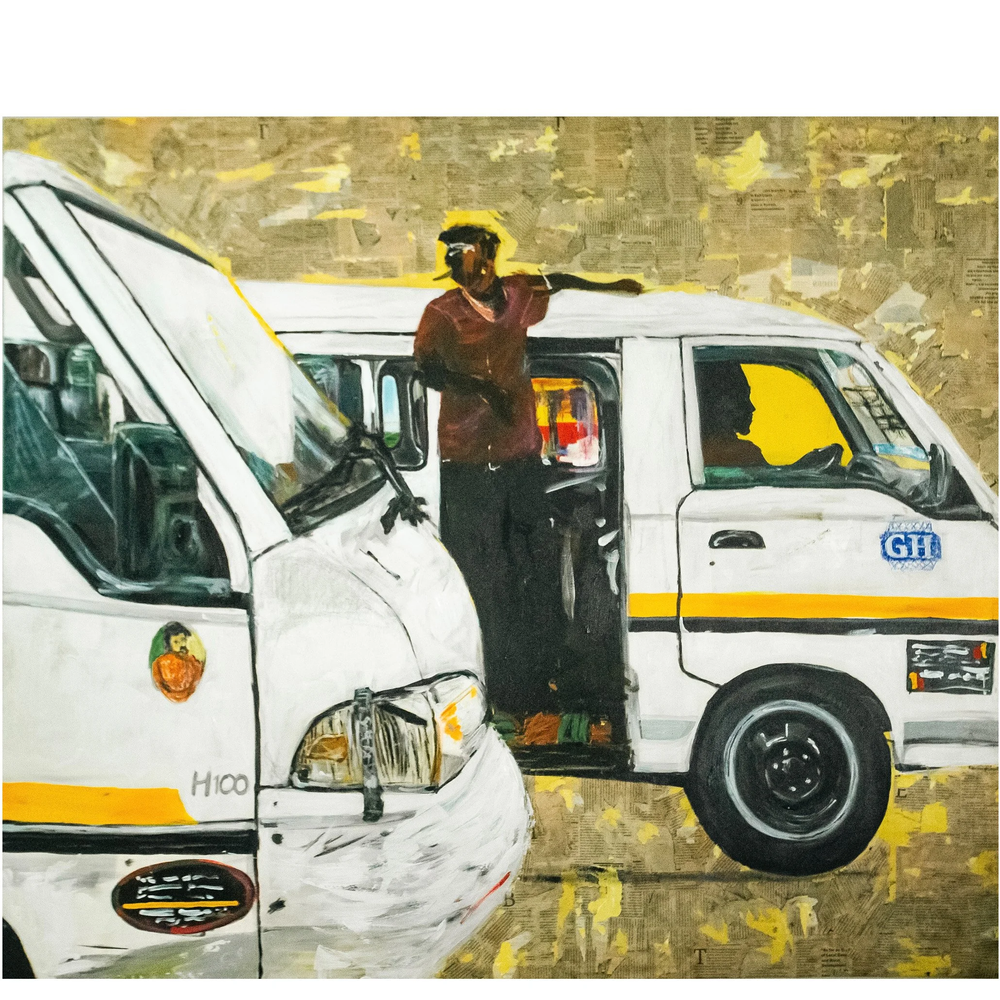
Title: Coins and consequences.
Artist: Kɔsi Gobah (b. 2002).
Date: 2025.
Medium: Acrylic, newspaper and coffee on canvas.
Dimensions: 140 cm x 120 cm.
Classification: Paintings