
Artist Ashiata Shaibu and the Inner Life

V. L. K. Djokoto
There is a simple idea at the centre of Ashiata Shaibu’s art: much of human life cannot be seen. We can see a person’s face, clothes and surroundings, but we cannot easily see memory, fear, desire, faith or grief. Yet these unseen things often have more influence over a person than the physical world around them, and Shaibu’s work attempts to give them a form.
The Nigerian artist, currently an artist in residence at dot.ateliers in Accra, works mainly with acrylic and paper collage on canvas. Her paintings are figurative, but they do not attempt to reproduce ordinary life exactly as it appears. Instead, her figures often exist between the real and the imagined, allowing her to consider not simply what a person looks like, but what may be happening inside that person.
Born in 1998, Shaibu-Salami Ashiata comes from Kogi State and grew up in Ibadan, one of Nigeria’s most important cultural and intellectual cities. Her practice has included painting, collage, impasto, sponging and image transfers, while her recent work has increasingly brought acrylic and paper collage together. Across these different methods, she has developed an interest in the relationship between the human figure, memory, nature and the imagined world.
Her work has also been shaped by anthropology and ancient mythology, particularly stories involving women in Greek and Egyptian traditions. This is important because mythology is not simply about the past; a myth survives because the human problem inside it survives. Civilisations change, but people continue to experience love, jealousy, ambition, betrayal, loss, sacrifice and hope.
Shaibu therefore uses old stories to think about present conditions. The ancient woman and the contemporary African woman may belong to different societies, but they can still encounter similar questions of power, expectation, love and suffering. By bringing these worlds together, Shaibu suggests that human emotions can travel across history even when the societies around them have changed completely.
Her interest in women from ancient mythology is especially significant for this reason. Women in old stories are often made to carry enormous meanings: they become mothers, queens, victims, lovers, goddesses, rebels or symbols of beauty and destruction. The modern woman is also asked to carry meanings placed upon her by family, society, religion and culture, even when she has not chosen those meanings for herself.
Shaibu appears interested in this burden, but she does not present it in an obvious or heavy-handed way. Her women are not simply portraits of individual people, nor are they straightforward political symbols. They often appear to carry histories that existed before them, which gives the paintings a sense of inheritance and allows the individual figure to become part of a longer human story.
Every generation, after all, inherits something from the generation before it. We inherit names, customs, beliefs, family stories and ways of understanding the world, but we may also inherit fears, expectations and wounds. Not everything that is inherited can be touched, and not everything carried by one generation is consciously passed to the next.
This is where Shaibu’s use of collage becomes particularly effective. Collage is created by bringing separate pieces together, so that something taken from one place is given a different meaning in another. The technique therefore provides a useful visual language for an artist interested in memory, inheritance and the complicated process through which people construct a sense of themselves.
Memory itself works in much the same way. We rarely remember our lives as complete and orderly stories; instead, we remember pieces of them, sometimes without knowing why a particular moment has survived. A face appears, a conversation returns, or we suddenly remember a house, a song, an argument or an afternoon from many years ago.
The human personality is built partly from these fragments. Shaibu’s use of paper collage can therefore be read as more than an artistic technique, because the material itself helps to explain the idea behind the work. Pieces are cut, moved, joined and transformed, just as experiences from different periods of a life eventually become part of one person.
One of her works, Unspoken Chapters, makes this concern particularly clear. The title suggests that there are parts of a human story that exist without ever being properly said, whether because the person cannot explain them or because society provides no comfortable language for doing so. They remain chapters in a life, but they are chapters without words, and painting becomes another means of giving them expression.
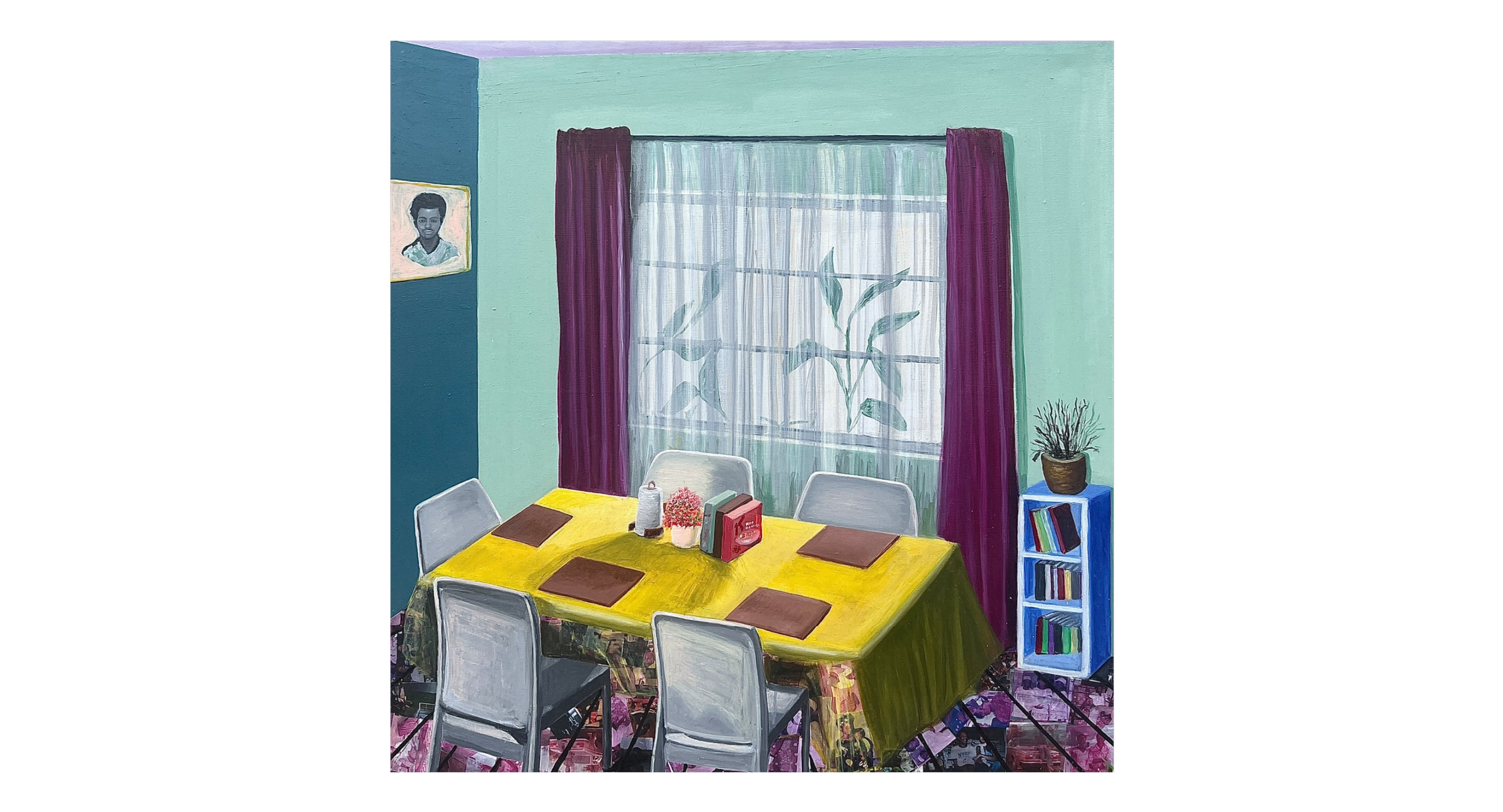
Unspoken Chapters, 2023
Acrylic and paper collage on canvas
36 × 36 in
The same idea appears in a work titled Unseen. Once again, the title directs our attention towards something that exists but is not immediately visible, asking the viewer to look beyond physical appearance. This concern with what lies beneath the surface is perhaps the strongest and most consistent argument within Shaibu’s developing practice.
Modern culture places enormous value on being seen. We photograph ourselves constantly, publish parts of our lives online and increasingly explain ourselves to audiences we may never meet. Yet visibility is not the same as understanding, and a society with more images than any previous civilisation may still know surprisingly little about the inner lives of the people appearing in them.
A photograph can show a smiling person without showing sadness. A beautiful room can conceal loneliness, just as a confident face can hide fear or uncertainty. Shaibu’s paintings occupy this space between appearance and experience, reminding us that the visible person is never the complete person.
Nature provides another important part of this argument. Flowers, landscapes, water and imagined natural environments appear in her work as more than decoration, because they provide spaces in which the human figure can exist outside the ordinary pressures of social life. Shaibu has associated nature with rest, healing and spirituality, and this helps to explain why some of her landscapes seem closer to emotional states than to places that could actually be found on a map.
The titles of her works reinforce this impression. Blue Flowers on a Dewy Morning, By the Nothingness Lake, Lingering in Time, Into The Starry Night and Where We Once Danced all suggest places located somewhere between memory and imagination. There is poetry in these titles, but there is also a consistent attempt to connect the physical world with an emotional one.
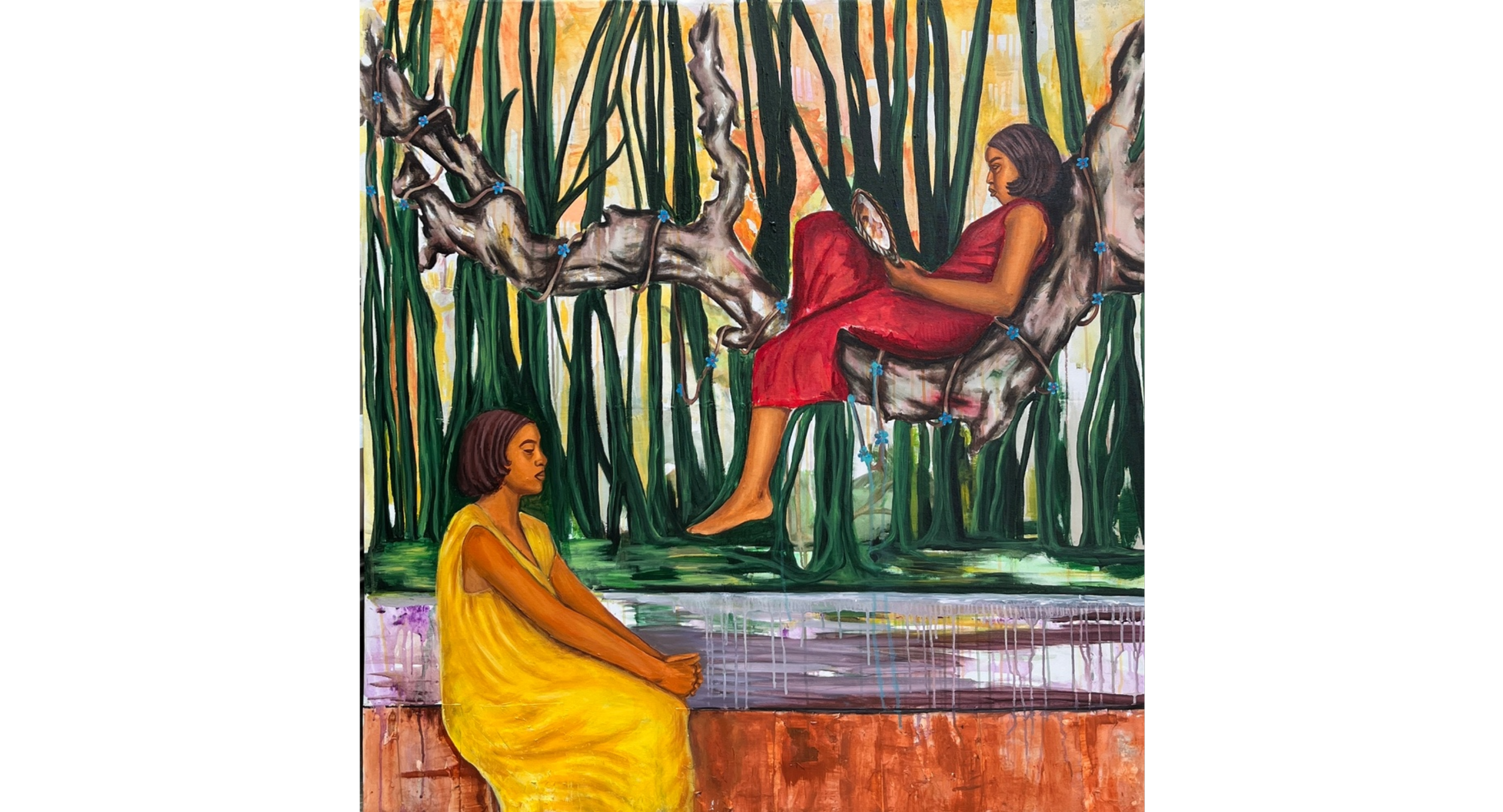
Lingering in Time, 2025
Acrylic and Paper collage on Canvas
48 × 48 in
This does not mean that the paintings are simply attempts to create beautiful or peaceful worlds. Their importance lies in the relationship between the person and the environment surrounding her, and in the possibility that an imagined landscape may reveal something about a person’s internal condition. Nature becomes a way of thinking about the self, rather than merely a background against which the self is painted.
Shaibu’s treatment of women deserves the same careful reading. In 2025, she participated in Daughters With Wings at 202 Gallery in Lagos, an exhibition bringing together seven Nigerian women artists around questions of womanhood, lineage, resistance and cultural silence. Shaibu contributed a work titled What It Carries, a title which again returns us to the difference between what can be seen and what can only be experienced.
To carry something does not necessarily mean that another person can see it. A person may carry responsibility, grief, memory, expectation or disappointment for years without displaying any physical sign of that burden. Women have historically been expected to carry many such burdens, including expectations surrounding respectability, beauty, marriage, motherhood, family and sacrifice.
Shaibu’s work gives us a way of thinking about this condition without reducing women to victims. Her figures can appear vulnerable, but vulnerability is not the same as weakness; they can also appear thoughtful, distant, calm, uncertain or powerful. This complexity matters because good art should not replace one stereotype with another, and women must be allowed the same contradictions that we accept in every other human being.
This is also where Shaibu’s work becomes interesting from the perspective of cultural theory. Culture does not exist only in monuments, festivals, music, clothes or public ceremonies; it also operates inside people by teaching them what to value, what to fear and what is expected of them. The private life is therefore never completely private, because the language through which we understand ourselves has already been shaped by the society around us.
Shaibu’s current residency in Accra should be considered against this background. Artist residencies matter because they remove artists from familiar surroundings and place them within new social and cultural environments. A different city changes ordinary habits: the streets are unfamiliar, languages enter the ear differently, social codes change, and even familiar objects can acquire new meanings.
For an artist concerned with memory and inner experience, these changes can become important material. Accra and Ibadan are different cities, but both belong to a wider West African cultural world shaped by colonialism, religion, migration, trade and rapid urban change. Both are places where modern life exists beside older systems of belief, and where the distinction between the traditional and the modern is far less tidy than textbooks sometimes suggest.
The encounter between Accra and Shaibu should therefore not be treated simply as another international residency. It belongs to a larger and more important question about how African cities relate culturally to one another. For too long, the development of the African artist has often been described through a route in which Africa produces the artist while Europe or North America provides the validation.
That model deserves to be challenged. An artist from Ibadan should be able to develop an important part of her practice in Accra, just as a Ghanaian artist should be able to find serious audiences in Lagos, Dakar, Abidjan or Johannesburg. African cultural exchange should not always require London, Paris, Berlin or New York to act as the middleman.
This is one reason institutions such as dot.ateliers matter. The movement of artists between African cities creates conversations between artists, collectors, curators, critics and audiences who might otherwise encounter one another mainly through international institutions. More importantly, it allows African societies to look at one another directly rather than constantly looking at themselves through somebody else’s cultural mirror.
Accra is particularly interesting territory for an artist concerned with the relationship between the visible and invisible. This is a city where churches, shrines, banks, galleries, markets, funerals, nightclubs, family houses and corporate offices exist within the same cultural landscape. The modern and the spiritual are not neatly separated, and neither are the commercial and the ancestral.
We should not romanticise this condition. Accra is also a city of inequality, congestion, displacement and increasingly difficult questions about land, belonging and development. Yet these contradictions are precisely what make cities culturally productive, because different ideas of what life should be are forced to occupy the same physical space.
There is also a lesson here for Ghana’s own art community. We often become interested in artists after somebody else has declared them important, usually when a major foreign gallery signs them, their work enters an international collection or their prices begin to rise. By that stage, we are sometimes responding less to the art itself than to the authority of the institutions that have already approved it.
A serious cultural society should behave differently. Critics, collectors, newspapers, universities and galleries should watch artists while their ideas are still developing, because criticism should participate in the formation of cultural value rather than merely report it afterwards. We should discuss technique as seriously as price, ideas as seriously as celebrity, and artistic development before international validation makes admiration fashionable.
This does not mean that every young artist should be celebrated without judgement. Shaibu has participated in exhibitions including Interconnected in 2022 and Daughters With Wings in 2025, and her work has appeared through galleries and art platforms within Nigeria and beyond. These are reasons to pay attention, but they are not reasons to declare a final verdict on an artist whose language is still developing.
Indeed, the absence of a final verdict is part of what makes this stage of an artist’s career interesting. We can watch ideas being tested, methods changing and certain themes becoming stronger while others disappear. Cultural criticism is most useful when it accompanies this process with curiosity and judgement, rather than arriving only after the market has decided what the work is worth.
At present, Shaibu appears to be building a clear argument about the relationship between what we show and what we carry. Her paintings bring together memory, womanhood, nature, spirituality, mythology and inherited experience, while her use of collage provides a suitable material language for these concerns. The work becomes most interesting when these different elements meet without being forced into a single explanation.
There is the visible figure, and behind it is an invisible history. There is the individual woman, and behind her are other women, other generations and sometimes ancient stories. There is the physical landscape, and behind it is an emotional one that cannot be measured by ordinary geography.
This is why Ashiata Shaibu is worth watching. Her art does not depend on noise, nor does it require every painting to announce a political position before the viewer has encountered the work itself. Instead, it begins with the quieter proposition that every human being contains a world which other people cannot fully see.
That proposition may be simple, but its consequences are not. If the inner life matters, then memory matters; if memory matters, inheritance matters; and if inheritance matters, then the individual can never be understood entirely outside history and culture. Shaibu’s work leads us through these questions without pretending that painting can provide a final answer to them.
Accra may now add something new to this developing language. We should resist predicting exactly what that contribution will be, because the purpose of an artistic residency is discovery rather than confirmation. The more useful position is to watch what happens when an artist concerned with unseen worlds encounters a city carrying so many unseen worlds of its own.
There is something fitting about that meeting. Accra is a city of visible and invisible things, modern and ancient, commercial and spiritual, restless and deeply attached to memory. It carries histories that are loudly celebrated, histories that are bitterly contested and histories that remain almost entirely unspoken.
Ashiata Shaibu arrives with memories of her own. She enters a city carrying memories of its own, and somewhere between the artist and the city, another set of fragments may begin to take shape. What eventually appears on the canvas will matter, but so too will the deeper question her work already asks us to consider: how much of a human life can ever truly be seen?