
Inside the Mind of artist Chaotic Korsi
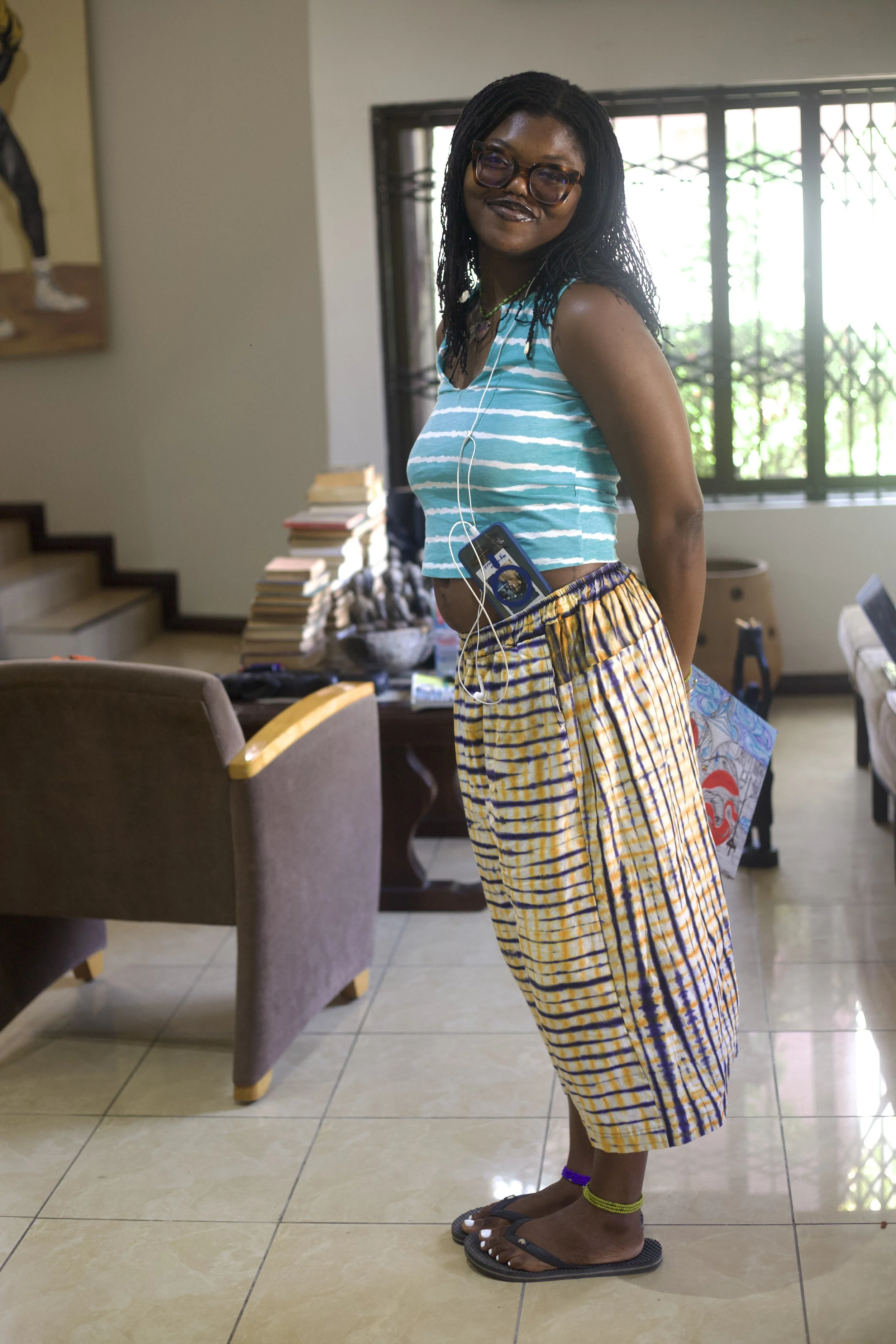
Photograph by the author
V. L. K. Djokoto
There is, dear reader, a certain species of artist — and Accra, rather like any city with a healthy appetite for self-expression, is positively teeming with them — who will, if you so much as glance at their canvas, embark upon a peroration of quite epic length as to what the yellow signifies, what trauma the ochre encodes, and why, precisely, Tuesday’s blue is not to be confused with Wednesday’s. Chaotic Korsi, I can report after considerable — nay, gruelling — journalistic exertion, is emphatically not of this tribe. She regards the artist’s job as being to paint, full stop, entire, rather than to bolt onto the painting a sort of explanatory kiosk, manned twenty-four hours, for the benefit of the perplexed.
Her ideal exhibition, as she describes it, is a thing of magnificent simplicity: she draws, the good people of Accra roll up in their finery, everybody has a marvellous time, somebody eventually names the painting by acclamation, rather in the manner of a chief being enstooled, and off everybody trots. Meaning, in the Korsi worldview, is not something the artist parcels up and hands out at the door like a party favour. It is squeezed — I use her own robust verb — out of the thing by whoever happens to be standing in front of it.
Even her own favourite work has, with a sort of magnificent irony, escaped her entirely: the painting sold, and she is left holding only a photograph of a thing she no longer owns — a bit like a man fondly reminiscing about a house he used to live in.
I ask her — bracing myself, notebook aloft — to describe herself in three words.
She has, initially, no earthly idea.
Then, after a pause of real gravity: chaotic.
“What,” I press, “does chaotic mean?”
General mess, she explains. When pushed to define the mess, she offers, with magnificent Ghanaian economy: “General mess.”
I put it to you that this is, in its way, a perfectly formed answer, rather better than most I receive from people paid considerably more to answer questions.
She scatters, she tells me, in order to organise — which strikes me as roughly the operating principle behind a good trotro mate’s accounting, tallying fares from memory amid what looks, from outside, like total anarchy: apparent chaos concealing, if you squint, a system. She wants to freestyle, but with method; to improvise, but with a plan lurking somewhere beneath the improvisation, rather like kenkey wrapped discreetly in its leaf.
I’m constantly arranging what's in my head,” she says — and there, reader, is your headline. Not a woman without order. A woman whose order is simply not for public viewing.
Before the Chaos
We rewind. Before the paintings, before the Ludo empire, before the whole splendid ecosystem she has assembled for herself in this city, there was Corpus Christi, then Achimota — that great and venerable institution — and finally the University of Ghana, Legon, African Union Hall. She finished school in 2014 and recalls it, on the whole, fondly, though without the sort of undergraduate mythology one associates with certain more scandalous alumni elsewhere. She simply went through it, with the eminently sensible aim of passing.
Beneath the surface, however, something quieter was under way. At Achimota she was a committed Christian — hours of prayer, she recalls, positively hours — before she began asking questions to which the catechism offered no satisfactory reply, and discovering, besides, that she did not much care for praying as a pastime. She wished also to explore matters of the heart, and indeed other matters, without what she felt was religion’s accompanying moral pantomime. One evening she had a drink: 8pm.
It was, by her account, disgusting.
One gathers the exploration rather outpaced the drinks cabinet.
At Legon there was less of this — she remained, for a good while, a Christian, before eventually moving off campus. Asked whether, given the choice again, she’d repeat the whole exercise, she says she probably wouldn’t bother with school at all — a sentiment no admissions brochure has ever printed, and yet one suspects half the country privately agrees.
Ludo, Work, and the Rage-Quit
Korsi loves Ludo — and has, with real entrepreneurial elan, built something resembling a small empire around games in this city, where, as I understand it, absolutely everything eventually becomes either a business, a hangout, or both, rather in the manner of a good chop bar.
Before art claimed her, she tried the corporate world, and rather enjoyed it — for a while. Then the responsibilities piled up, as responsibilities do, the way orders pile up at a busy waakye stand on a Friday morning, and the job began to crowd out whatever life she was trying to build alongside it. A cool experience, she says. Not, however, the road to riches.
So she rage-quit — her phrase, and a far more honest one than “pursuing new opportunities,” which is what the rest of us say when handing in our resignations under duress.
She felt, in her own words, tricked by the universe.
The universe, it turns out, had other plans. She hunted for another job. Nothing quite fit. And then came an offer of such magnificent audacity that her first reaction was, verbatim, “what the fuck?”: leave the corporate job entirely, become a full-time artist, run events, and do work that sounded, frankly, like nothing much at all.
And yet — as with so many apparently mad ventures — it worked.
She is no habitual quitter, she insists; the corporate exit was the exception, not the credo. She kept at the search until the improbable thing arrived, and then she took it.
Now she speaks of staying in Accra with something like the conviction of a founding ancestor — she is meant, she says, to lay roots here, like an ancestor. Grand talk, for someone merely declining to move house. But then, Chaotic Korsi was never one for the modest turn of phrase.
The Artist, Confused
What, I ask, is it like being an artist?
“It's confusing,” she says. A pause. “I'm confused. I don't know what is going on.”
Which is, I submit, the most honest sentence uttered by any artist since records began.
She is captivated by the mechanics — the materials, the process, the sheer physical business of making the thing — but beyond that, certainty rather deserts her. She does not pretend to understand why ink on canvas should produce some profound spark of connection in a stranger. She simply gets on and does it, creating first, interpreting — if ever — considerably later. Asking her to explain a painting is a bit like asking a man to explain his dream while he is, regrettably, still having it.
Worthy Hands
There is a deeper uncertainty still. Korsi does not see motherhood as her destiny, and doubts she has the particular reserves of care it demands. Nor does she see art as an obligation owed to anyone else — not to an audience, not to a nation requiring explanation to the wider world. Her duty, as she frames it, is smaller and, somehow, larger.
“My hands are worthy.”
There it is — the whole philosophy in four words, rather more concise than most of us manage in a paragraph. The artist need not have the answers. She need only trust the hands doing the work. Status, money, the usual scorecards — she has learned to do without them and remain, nonetheless, worthy.
She is, in effect, betting that others will find their own meaning in the work, so that she is spared the trouble of manufacturing one to order.
And there, dear reader, is the great, glorious contradiction of Chaotic Korsi: she declares herself chaotic while constantly tidying the furniture of her own mind; she craves spontaneity yet plans for it; she scatters only so that she might later organise; she distrusts tidy explanations while spending her days trying to work out how things actually function; she will not tell you what her art means, and makes more of it anyway.
There is, in short, method in the mess.
A painting, it turns out, does not require its creator standing beside it with a dictionary and a lectern. It requires only a room, a pair of eyes, and enough silence for somebody to squeeze a meaning out of it themselves.
Korsi, meanwhile, will be found nearby — rearranging the chaos in her head, plotting the next move, playing Ludo, painting another canvas, and wondering, along with the rest of us, what on earth is going on.
Which, do you know, seems for now to be working rather beautifully.