
The Water Crisis No One Is Discussing: Why Ghana’s Approaching Catastrophe Demands Radical Rethinking
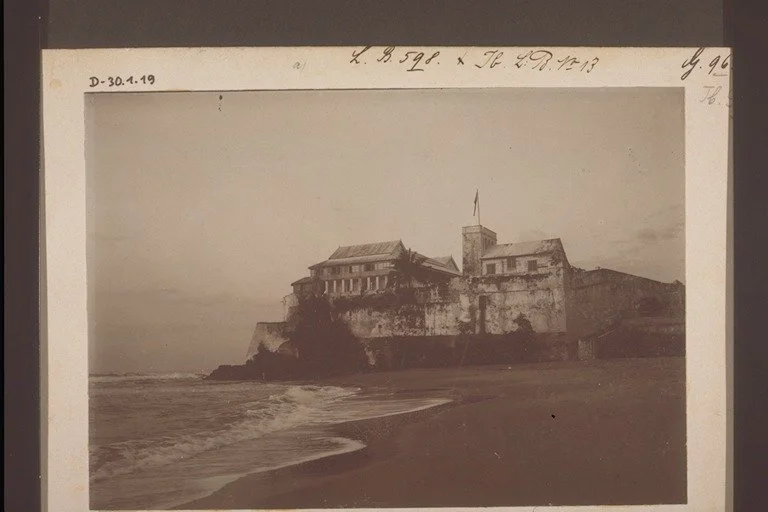
Title: “Schloss Christiansborg.”
Creator: Fisch, Rudolf (Mr)
Date: 01.01.1885-31.12.1911
An analysis of the structural paralysis afflicting national water supply and the unpalatable choices ahead
The statistics emerging from Ghana Water Company Limited warrant far more alarm than they have generated. Nearly GH¢2 billion in unpaid debts. Over half of all water produced vanishing before it can be billed. A weekly shortfall of 73 million gallons in the capital alone. These are not mere operational inefficiencies — they represent the anatomy of state failure in a critical sector.
Yet the response — launching “Revenue Enhancement Teams” — suggests a fundamental misdiagnosis of the crisis at hand. This is not primarily a revenue collection problem that can be solved through better enforcement. It is a legitimacy crisis masquerading as a technical challenge, and until this is understood, no amount of debt recovery will address the underlying pathology.
The Illusion of the Technical Fix
Managing Director Adam Mutawakilu’s explanation that losses derive from technical failures (32%) and commercial losses (78%) is accurate but incomplete. What this framing obscures is the question of causation: why do customers refuse to pay, why do illegal connections proliferate, and why does water theft occur on such a massive scale?
The answer is uncomfortable: the social contract underpinning the water utility has collapsed. When supply is erratic, when taps run dry for weeks, when those with connections receive intermittent service whilst witnessing water tankers serving the affluent, payment becomes discretionary rather than obligatory. The debt is not merely financial but moral— GWCL has failed to deliver on its end of the bargain, and citizens have responded in kind.
Consider the perverse logic now in operation: GWCL cannot invest in infrastructure because customers do not pay; customers do not pay because service is unreliable; service is unreliable because infrastructure investment is insufficient. This is a self-reinforcing spiral that enforcement teams cannot break. Indeed, aggressive debt collection in the absence of improved service may accelerate the breakdown of whatever residual trust remains.
The Fallacy of Equal Treatment
The debt figure of GH¢2 billion invites a crucial question that GWCL’s public statements carefully avoid: who owes this money? The composition of the debt determines whether it is recoverable and what recovery would entail.
If a substantial portion is owed by government institutions, ministries, or state enterprises — as is typically the case —then the crisis is fundamentally one of inter-governmental accounting rather than public malfeasance. The state owes itself money it cannot pay because different arms of government operate under different fiscal constraints. “Revenue enhancement” in this context is simply moving debt from one public ledger to another.
If, conversely, the debt is primarily household arrears, then enforcement raises profound questions of equity and political sustainability. Disconnecting thousands of homes for non-payment whilst state institutions remain connected despite larger arrears would be politically combustible and morally indefensible. Yet maintaining universal connection whilst revenues collapse merely postpones the inevitable reckoning.
The third possibility — that commercial and industrial users represent significant debtors — suggests a different dynamic entirely: businesses making rational calculations that the cost of non-payment (uncertain enforcement) is lower than the cost of payment (certain expense). This indicates not a collection problem but a credibility problem.
The Real Crisis: Absence of Consequences
The most revealing statistic is not the GH¢2 billion owed but the fact that it has been allowed to accumulate. This represents years of non-payment without meaningful consequence. What rational actor would pay for unreliable water when non-payment carries no penalty?
The new Revenue Enhancement Teams face an impossible mandate: to suddenly enforce rules that have been systematically unenforced for years. Those who have not paid will reasonably ask: why now? Those who have paid will reasonably ask: why did we bother? And those receiving poor service will reasonably ask: why should we pay for water we do not receive?
Without addressing these questions, enforcement becomes arbitrary exercise of power rather than legitimate implementation of policy. And arbitrary power, however necessary it may seem, corrodes the institutional foundations required for long-term sustainability.
Advertisement
D. K. T. Djokoto & Co Ad
The Unspoken Choice
Ghana faces a choice that politicians are understandably reluctant to articulate. The current model — universal access at subsidised rates with intermittent service and voluntary payment — is financially unsustainable. Something must give.
Option one: Maintain the pretence of universal service whilst quality deteriorates further, debts accumulate, and the system gradually fails. This is politically comfortable in the short term but catastrophic in the medium term.
Option two: Implement true cost-recovery pricing with reliable service for those who can pay and basic provision for those who cannot. This is politically toxic but operationally coherent.
Option three: Explicit subsidy, with government transparently funding the gap between cost and revenue through direct budget allocation rather than allowing GWCL to accumulate unpayable debts. This is fiscally honest but requires acknowledging that water access is a social service rather than a commercial enterprise.
Option four: Radical decentralisation, with community-level management of water systems, local accountability for payment and maintenance, and abandonment of the fiction that a centralised utility can effectively serve both Accra’s elite and remote rural communities with the same model.
Each option entails genuine sacrifice. The current approach entails the appearance of avoiding sacrifice whilst ensuring the worst possible outcome: progressive system failure that will eventually force a crisis too severe to manage incrementally.
Why Enforcement Will Fail Without Reform
The Revenue Enhancement Teams will likely achieve some initial success. They will disconnect some households, collect some debts, and generate encouraging quarterly reports. But without addressing the underlying dynamics, these gains will be temporary.
Consider what happens when teams begin aggressive enforcement. Those with political connections will be exempted or receive special arrangements. Those without such connections will be disproportionately targeted. This will be noticed, and it will corrode whatever legitimacy the exercise might have had.
Meanwhile, the 73 million gallon weekly shortfall in Accra will persist. The 114 million gallons of daily non-revenue water will continue vanishing. The aging pipelines will keep leaking. And citizens will observe that whilst they are being pressured to pay more, they are receiving no more water.
The fundamental error is treating this as a revenue problem when it is actually a governance problem. Revenue collection is the symptom, not the disease.
What Actual Reform Requires
Genuine resolution demands several uncomfortable steps that go far beyond enforcement teams.
First, complete transparency on debt composition. Who owes what, for how long, and under what circumstances? Without this, public discussion remains speculative and policy remains arbitrary. If government institutions owe billions, this should be publicly acknowledged and a plan for resolution articulated—even if that plan involves writing off inter-governmental debt as a one-time reset.
Second, explicit service guarantees tied to payment obligations. Citizens cannot be expected to pay reliably for unreliable service. GWCL must commit to specific supply standards for specific areas, with transparent monitoring and consequences for failure. Payment obligations then become reciprocal rather than one-sided.
Third, differential pricing that acknowledges different capacity to pay whilst maintaining basic access. The current model pretends all consumers are identical; they are not. Large commercial users can and should pay cost-recovery rates. Residential users might pay tiered rates. Essential access for the poor might be explicitly subsidised rather than hidden in cross-subsidies that make the entire system unsustainable.
Fourth, genuine devolution of authority to regional and district levels, with local accountability for both supply and payment. The fantasy that Accra can micromanage water supply across the entire nation has demonstrably failed. Local systems with local accountability create stronger incentives for both performance and payment.
Fifth, political courage to acknowledge that water access, like healthcare or education, may need to be treated as a public service with transparent subsidy rather than a commercial enterprise that must be self-financing. If society has determined that universal water access is a right regardless of ability to pay, then this should be funded through general taxation rather than through accumulating unpayable debts within a utility company.
The Political Economy of Failure
The current crisis persists because it serves certain interests, however perverse that may seem. Politicians can claim commitment to universal access without funding it. Consumers can receive water without paying for it. GWCL management can attribute failure to factors beyond their control. Connected individuals can secure reliable supply through informal arrangements. Everyone adapts to dysfunction because the cost of reform—which would create clear winners and losers — seems higher than the cost of muddling through.
But there is a terminus to this trajectory. Infrastructure does not degrade linearly; it fails catastrophically. Public tolerance is not infinite; it snaps. Fiscal pressures do not ease; they compound. The question is not whether the current model will fail but whether it will fail in a manner that permits orderly transition to something better or chaotic collapse into something worse.
Conclusion: The Crisis as Opportunity
The GH¢2 billion debt and the 73 million gallon weekly shortfall are not unfortunate anomalies to be corrected through better management. They are the logical outcome of contradictory objectives pursued simultaneously: universal access, cost recovery, reliable service, and voluntary payment. These goals are not all achievable within the current framework.
The Revenue Enhancement Teams may collect some debts. They will not resolve the crisis. That requires political leadership willing to make genuine choices rather than pretending that technical fixes can substitute for policy clarity.
The water crisis offers an unexpected opportunity: to rethink not just water provision but the broader relationship between state capacity, citizen obligation, and service delivery. Done properly, reform could establish principles applicable across the struggling public sector. Done poorly — or not at all — it ensures that today’s water crisis becomes tomorrow’s broader state failure.
The Kissinger doctrine in international relations held that crises should be resolved in ways that create better conditions for managing future challenges rather than merely returning to the status quo ante. Ghana’s water crisis demands similar thinking: not restoration of a system that was already failing, but transformation toward one that might actually work.
The question is whether political leadership possesses the courage to choose a painful sustainable path over a comfortable road to catastrophe. The clock is not merely ticking; with 73 million gallons of unmet demand each week, it is flooding.