
The Collector’s Eye: Why Atta Geoman Matters
V. L. K. Djokoto
In Ghana’s young art market, the next generation of collectors will have to look beyond the obvious names. Atta Geoman offers a case in point.
There is a certain moment in collecting when the pleasure of acquisition gives way to something more interesting: the pleasure of discovery.
The established names will always command attention. Their works hang in the homes of the well-appointed, in hotel lobbies, corporate boardrooms and the increasingly sophisticated private collections of Accra. But an art market is not sustained by yesterday’s reputations alone. It is built, quietly and patiently, by collectors willing to look again at the artists whose careers have been developing outside the glare of fashionable auctions and international fairs.
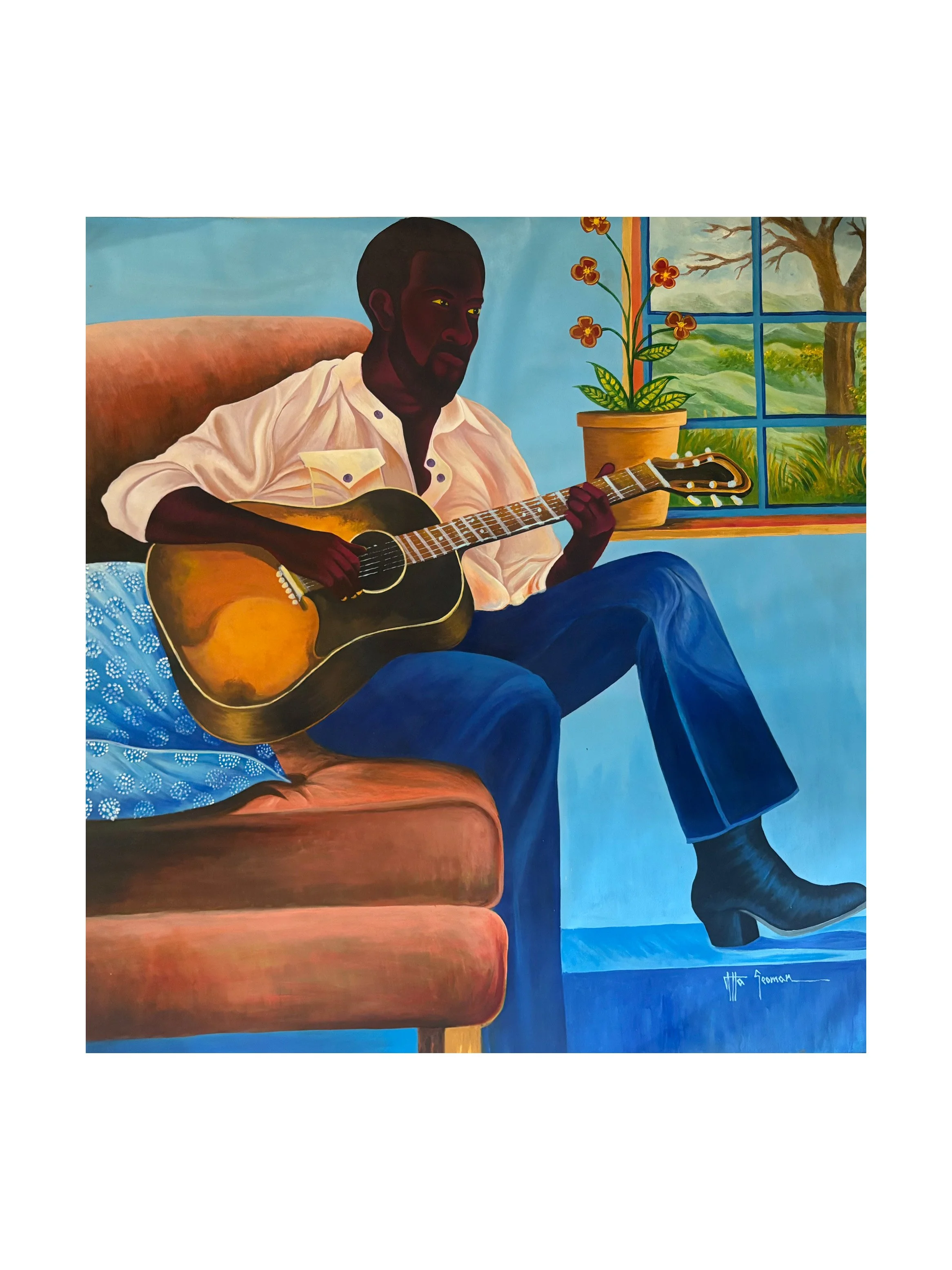
It is in this spirit that Ka xoxowo Salon’s boutique art investment desk has been acquiring works over the past year. Its latest addition is Melody, an acrylic on canvas by Ghanaian artist Atta Geoman (b. 1977).
At 45¼ × 48 inches, Melody is not a timid picture. It possesses the physical presence expected of a work intended to occupy a serious wall, but its significance lies beyond its dimensions. The acquisition is also a reminder that Ghana's contemporary art history is considerably broader than the names most frequently encountered in the international marketplace.
Geoman belongs to a generation of Ghanaian artists whose careers were formed through a distinctly local ecology of art schools, private studios, cultural festivals, hotels, galleries and exhibitions. It is an ecosystem that deserves greater attention from collectors.
The younger of twins, Geoman began his artistic education at St. John’s Grammar School, Achimota, studying Visual Arts before proceeding to the Ultimate School of Arts in Mamprobi between 1997 and 1998. There he trained under artists and instructors including Uncle Sam, Atta Okoh and Mr. Crabbe.
His exhibition history began early. In 1999, 2000 and 2001, he exhibited at PANAFEST, one of Ghana's most important cultural festivals. In January 2005, he held a month-long exhibition at the Golden Tulip Hotel. The following year he exhibited at the Novotel and participated in a group exhibition at the Ghana National Museum and Monuments Board alongside Kofi Baiden and William Agbanavor.
For the casual observer, these may appear simply as entries on a curriculum vitae. For the serious collector, they are something else: provenance of a career.
Artists do not emerge fully formed. Their reputations are accumulated through years of exhibitions, teaching, experimentation, relationships and institutional recognition. Before an artist becomes a familiar name in the secondary market, there is usually a long period in which the work is being made, shown and acquired by people who are prepared to take an early interest.
This is where Ghanaian collectors have an opportunity.
The country's art market is maturing, but the collecting culture around it is still being written. There is considerable enthusiasm for contemporary African art internationally, yet the domestic collector should not simply follow the tastes of London, Paris, New York or Lagos. Ghana possesses its own artistic histories, and some of its most interesting practitioners have spent decades building bodies of work that are not necessarily reflected in international price lists.
The collector's task, therefore, is partly one of discernment.
It is not enough to ask whether a picture looks good above the sofa. One ought also to ask who made it, where they trained, who taught them, where they exhibited, what generation they belong to and whether the work contributes to a broader understanding of Ghanaian artistic life.
This is particularly important in a country where the preservation of cultural history has too often depended upon private initiative.
A painting in a private collection is not merely a possession. Properly documented, it becomes part of an archive. The artist's name, biography, medium, dimensions, date of acquisition and exhibition history can preserve information that might otherwise disappear with time.
Geoman now works from Geoman Studios in Amasaman, maintaining a practice away from the fashionable gallery districts of central Accra. Outside the studio, he also runs a rabbit farm. His musical tastes run from Michael Jackson and Lionel Richie to Celine Dion.
These details are charming, but they are also revealing. The Ghanaian artist is rarely a creature confined to the romantic mythology of the studio. Artists live ordinary, entrepreneurial, sometimes eccentric Ghanaian lives. They farm, teach, trade, raise families and build businesses while making art. The work emerges from that totality.
That is precisely why collecting Ghanaian art is an exercise in cultural memory as much as aesthetics.
Melody now enters the collection as both an artwork and a document of its time.
The larger point is perhaps the more important one. Ghanaian collectors should not regard the art market merely as a hunt for fashionable names. There is a richer opportunity available: to identify artists with substantial histories, understand their contribution to the development of Ghanaian visual culture, and preserve their work before the historical record becomes fragmented.
The most interesting collections are rarely assembled overnight. They are built through curiosity.
And sometimes, the most rewarding acquisition is not the picture everyone is already talking about, but the one that makes you ask: why have we not been talking about this artist enough?
That is the collector's eye.
And it is an eye Ghana will need more of.