
Highlife (2026): Reframing Power, Memory, and Celebration
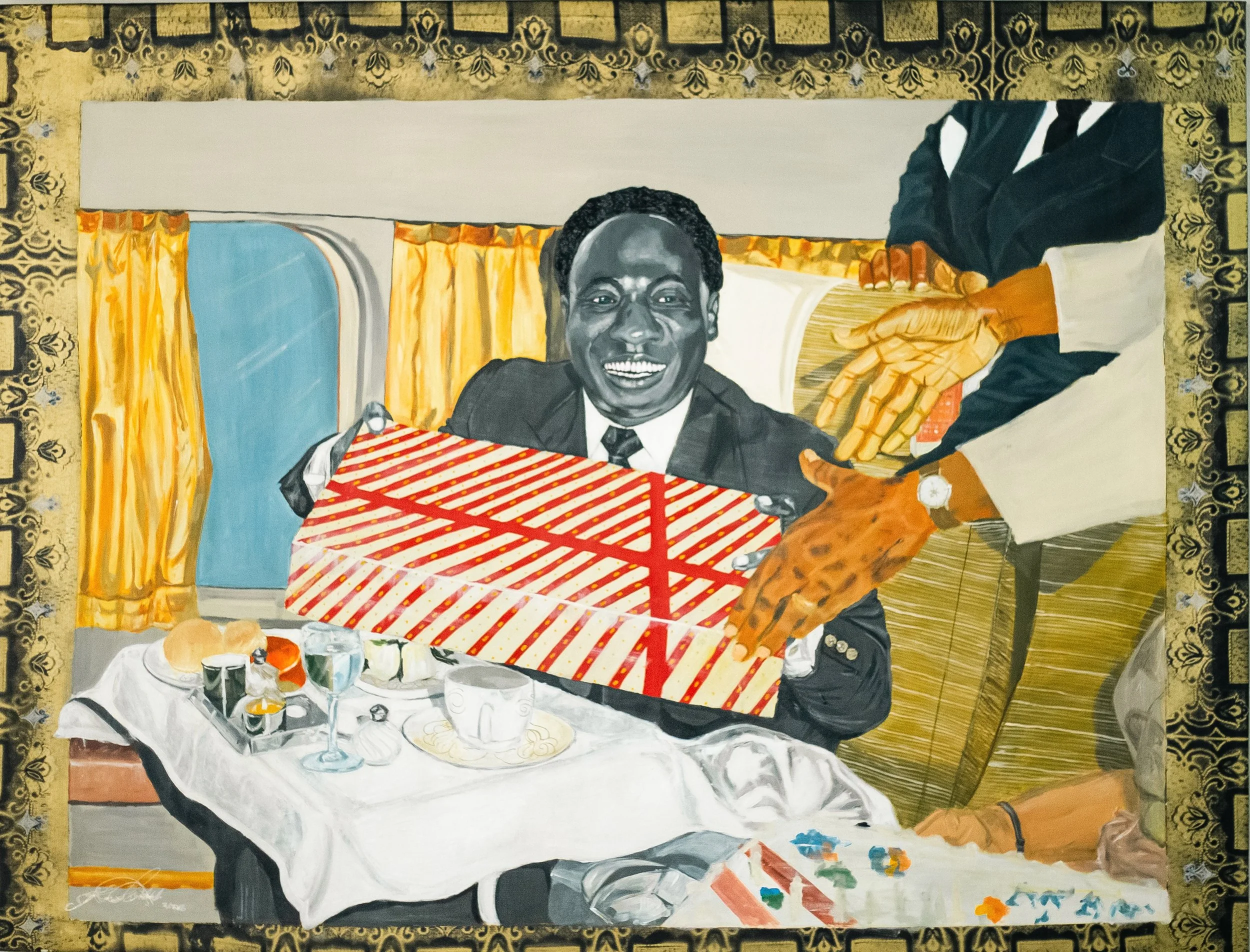
Title: Highlife.
Artist: Timothy K. Gobah (b. 2002)
Date: 2026.
Medium: Acrylic and spray paint on canvas.
Dimensions: 98 cm x 133 cm.
Private collection — Ka xoxowo Salon.
By V. L. K. Djokoto, Gallerist, Ka xoxowo Salon
In Highlife (2026), Timothy K. Gobah constructs a scene that is at once seductive and quietly disquieting — proof, if one needed it, that the most daring images are not those that shout, but those that smile. With the recognition that the central figure is Kwame Nkrumah — drawn from a photograph of him celebrating his birthday — the painting ceases to be merely about affluence and becomes instead a rather exquisite problem: how does one aestheticize power without betraying it, and how does one remember without inventing?
Gobah, to his credit, does not attempt the impossible. He does something far more interesting — he intervenes.
Nkrumah, rendered in grayscale, is at once present and unavailable, like a memory that refuses to fade yet declines to explain itself. Around him, colour behaves with a certain arrogance — gold insists, red declares, yellow lingers like gossip in a well-appointed room. The effect is unmistakable: history, it seems, has been invited to a modern dinner party, but has chosen to arrive in monochrome.
There is something deliciously ironic about a birthday — a celebration of time — being used here to suspend time altogether. A birthday is meant to be intimate, yet Nkrumah, even in celebration, cannot escape the burden of significance. One suspects he never could. The gift he receives — wrapped with almost aggressive elegance — appears less an offering than a proposition. After all, gifts, like compliments, are rarely innocent; they tend to conceal more than they reveal.
The hands that present this object are perhaps the painting’s most eloquent invention. They are too large, too deliberate, too knowing to be merely anatomical. They suggest a world in which power is always mediated — offered, withheld, negotiated — by forces that prefer not to show their faces. One is tempted to admire their generosity, until one realises that generosity, in politics, is often a form of authorship.
And then there is the setting: a private jet, that most modern of theatres for the performance of importance. It is, of course, an anachronism — Kwame Nkrumah never occupied such a space in this manner. But accuracy, in art, is frequently overrated. What matters is plausibility of feeling, and here Gobah is devastatingly precise. The jet becomes not a location, but a metaphor — history in transit, identity at cruising altitude, memory pressurised for contemporary consumption.
The title, Highlife, is a small masterpiece of suggestion. It gestures, with admirable restraint, toward both the musical tradition and the social condition it evokes. Yet one suspects Gobah is less interested in celebration than in its aesthetics. For what is the “high life” if not a carefully arranged still life of desire — objects, gestures, and symbols arranged just so, in order that they might be believed?
His use of acrylic and spray paint only deepens this ambiguity. There are passages of near-photographic clarity alongside moments of deliberate interruption, as though the painting itself cannot quite decide whether it wishes to document or to dream. The decorative border, rich and insistent, frames the entire scene with a hint of ceremony, as if we are not merely observers but guests — invited, though not entirely trusted.
What emerges is not a critique of Nkrumah — such a gesture would be both too easy and too dull — but a meditation on the peculiar afterlife of icons. To be remembered, one must first be transformed, and transformation, as Gobah demonstrates, is never a neutral act. The smile, borrowed from the original photograph, becomes here a kind of riddle: sincere, certainly, but also staged, rehearsed, perhaps even required.
Held in a private collection at the Ka xoxowo Salon, Highlife confirms Gobah as a painter of considerable intelligence — and, more importantly, of taste. He understands that the most compelling images do not resolve themselves; they linger, they provoke, they refuse the vulgarity of conclusion.
In repositioning Kwame Nkrumah within a scene of stylised luxury and exchange, Gobah achieves something rather rare. He makes history feel not distant, but fashionable — and in doing so, reminds us that power, like style, is always a matter of presentation.
One leaves the painting with a curious suspicion: that the gift, however beautifully wrapped, was never the point.
It is the gesture that endures.