
Freezy MacBones and the Persistence of the Ghanaian Fighter
Accra Evening News Editorial
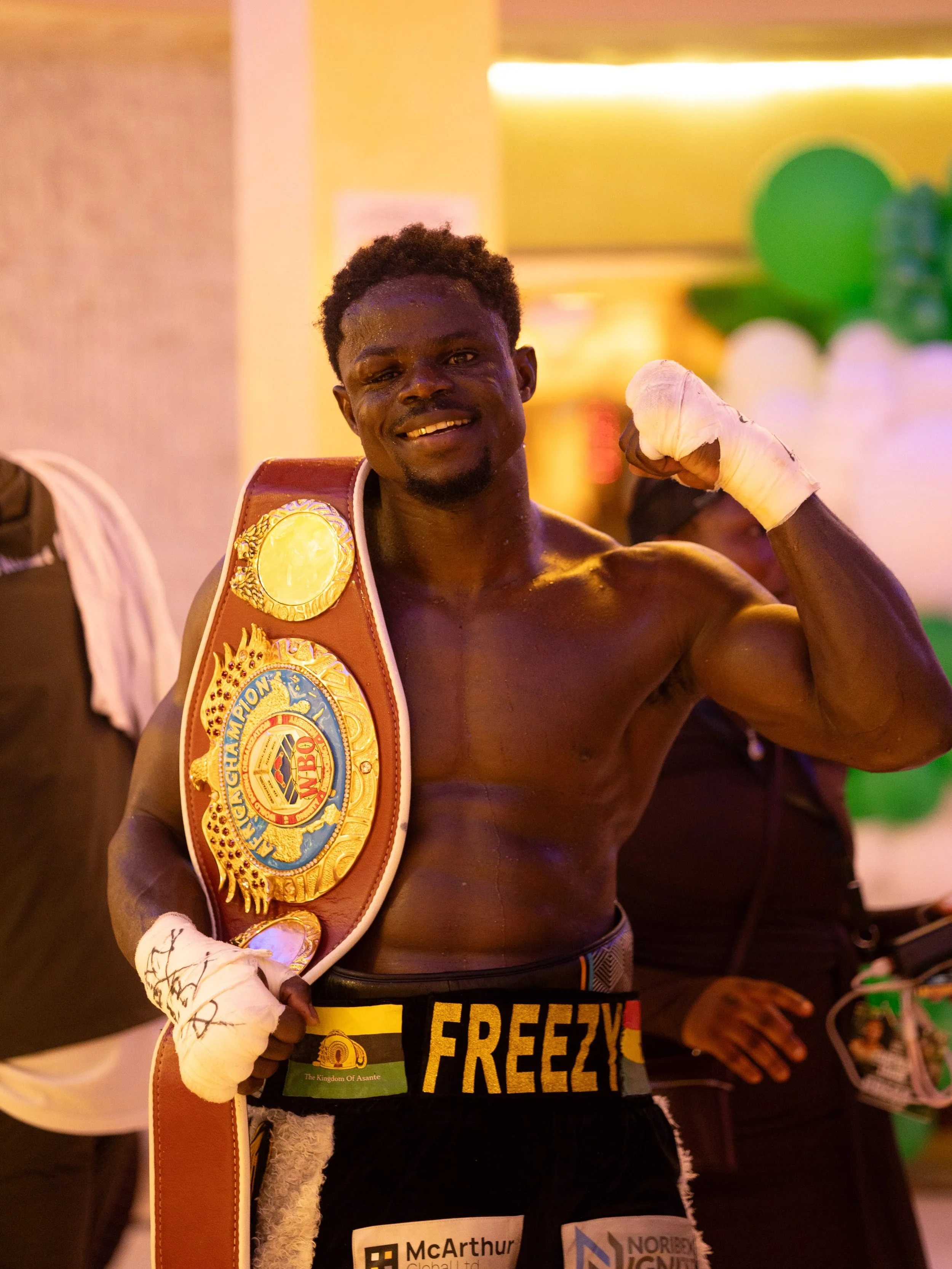
There are victories which add another belt to a boxer’s collection, and there are victories which explain something larger about the boxer himself. Seth Gyimah, better known as Freezy MacBones, has achieved the latter. At 37, the Ghanaian fighter has become the new WBO Africa Light Heavyweight champion, defeating Nigeria’s Godday “Zodsolo” Appah in Lagos on 1 October.
The circumstances make the victory particularly satisfying. MacBones travelled to Nigeria, fought the defending champion before a largely Nigerian audience on Nigeria’s Independence Day, and returned with the title. After ten rounds, the judges scored the contest 95–93, 95–93 and 94–94, giving the Ghanaian a majority decision.
But the importance of this victory cannot be understood from the scorecards alone.
MacBones represents a particular tradition in Ghanaian sport: the fighter who emerges without the comfortable machinery that usually surrounds elite athletes. His career did not begin in a polished academy where his talent was identified as a child and carefully managed towards professional competition. He began boxing at 27, an age at which many professional fighters have already accumulated years of amateur and professional experience.
Ten years later, he is a continental champion.
That fact deserves attention because professional sport is often obsessed with youth. Athletes are identified earlier, developed earlier and increasingly judged before they have had sufficient time to become themselves. In boxing especially, there is a tendency to imagine a fighter’s career as a narrow window which must be exploited before age inevitably closes it.
MacBones has complicated that assumption.
His story is not an argument against youth development. Ghana desperately needs better youth development in boxing and other sports. It is instead an argument for recognising that talent does not always arrive according to an institutional timetable.
Some people find their calling at sixteen. Others find it at twenty-seven.
The important thing is what happens afterwards.
MacBones has spent the past decade constructing himself as a boxer. There is something distinctly old-fashioned about that journey. Before professional sport became an industry of carefully managed brands, athletes were often understood through work: repetition, discipline, failure, recovery and the gradual mastery of a craft.
MacBones belongs naturally to that tradition.
His new championship is particularly meaningful because it follows disappointment. In December 2025, Jonathan “Worldwide” Tetteh defeated him by unanimous decision in their contest for the WBA Africa Light Heavyweight title in Accra. For a 36-year-old fighter, such a defeat could easily have become the point at which observers began speaking about what might have been.
Instead, MacBones returned.
That return matters almost as much as the victory itself. Sport has become very good at celebrating triumph and rather poor at explaining the long periods between triumphs. We see the belt around the waist, the photographs, the national flag and the applause, but rarely the months when an athlete must live privately with defeat.
A fighter must do something unusual after losing. He must study the very moment he would prefer to forget. He must watch the punches that caught him, examine the mistakes that cost him rounds and then return to training with the knowledge that none of his work guarantees a different outcome next time.
That is the cruelty and beauty of boxing. There is nowhere to hide.
Football allows defeat to be distributed among eleven players. A poor pass can be recovered by a teammate. A goalkeeper can save a defender from embarrassment.
Boxing offers no such comfort. When the bell rings, responsibility becomes brutally individual.
That is why the image of Freezy MacBones standing as WBO Africa champion in Lagos deserves more than the usual language of sporting congratulations. The title represents the recovery of a career after defeat. It is evidence that the previous chapter did not have to become the final chapter.
There is also something appropriately Ghanaian about the location.
Ghana and Nigeria have turned competition into a form of cultural conversation. We argue over football, music, food and popular culture with the familiarity of relatives who know precisely how to irritate one another. Boxing has now supplied another chapter.
MacBones did not simply win a continental championship. He defeated a Nigerian champion in Lagos on Nigeria’s Independence Day.
One need not indulge excessive nationalism to appreciate the theatre of it.
Yet the greater question for Ghana is what we do with fighters such as MacBones.
Ghana has one of Africa’s richest boxing traditions. From Azumah Nelson and Ike Quartey to David Kotey, Joshua Clottey and Joseph Agbeko, the country has repeatedly produced fighters capable of competing at the highest levels of the sport. The names change across generations, but the national relationship with boxing remains remarkably durable.
The tragedy is that our infrastructure has not always developed at the same pace as our talent.
Ghanaian boxing still depends too heavily upon extraordinary individuals overcoming ordinary systems. We celebrate the champion after the championship, when the more serious work should have begun years earlier. Training facilities, amateur competitions, sports science, coaching, promotion, athlete management and commercial sponsorship cannot remain secondary considerations if Ghana intends to recover its position as a major boxing nation.
The lesson of Freezy MacBones should therefore not be that determination makes institutions unnecessary.
It should be precisely the opposite.
Imagine what Ghanaian boxing could produce if the determination already visible in our fighters were matched by equally serious institutions around them. Imagine a national system capable of discovering talent early, supporting boxers properly, protecting them commercially and providing a clear route from amateur competition to continental and international championships.
There is talent in Bukom. There is talent in Kumasi. There is talent scattered across towns where young men and women may never encounter the coach, gym or promoter capable of recognising what they possess.
A sporting nation cannot depend upon luck to discover its champions.
MacBones also presents an interesting challenge to how Ghana thinks about its sporting diaspora. His development has been connected to Britain, but his sporting identity remains emphatically Ghanaian. His career therefore belongs to a growing reality in African sport: talent may be developed across borders while national identity remains powerful.
Ghana should understand this as an opportunity.
Our sporting ecosystem should maintain stronger relationships with Ghanaian athletes, trainers and promoters abroad. The movement of people between Accra, Kumasi, London and other sporting centres should not be treated as a loss of national talent. Properly organised, it can become a network through which knowledge, investment and professional standards return home.
For MacBones himself, however, the immediate task is simpler. He must keep fighting!
A continental championship is significant, but it is also a door. The WBO Africa Light Heavyweight title gives him a stronger platform from which to seek larger contests, greater international visibility and a higher position within the professional game. Reports following the Lagos victory already suggest another fight could come in December.
At 37, time naturally becomes part of every discussion about his career.
But perhaps that is precisely what makes this stage interesting.
MacBones does not have the luxury of treating the coming years as an indefinite development period. Every fight matters. Every training camp matters. Every decision about opponents, promoters and opportunities matters.
There is urgency now. And urgency, properly controlled, can produce clarity.
Freezy MacBones knows who he is as a fighter because he has taken the difficult route towards discovering it. He has known obscurity. He has known attention. He has known defeat.
Now he knows what it means to become champion.
Ghana should celebrate him, but our celebration should contain something more serious than applause. His story reminds us that Ghanaian boxing remains alive, even when the structures around it have not always reflected the depth of the country’s talent. It reminds us that champions can still emerge from unconventional beginnings and that defeat, however public, need not become destiny.
There will be harder fights ahead. A WBO Africa title is not the summit of international boxing, and MacBones himself will understand that better than anyone. The belt around his waist should therefore be regarded neither as a sentimental conclusion nor as evidence that the difficult work is finished.
It is evidence that the difficult work has produced something.
In Lagos, a 37-year-old Ghanaian who only began boxing at 27 walked into another man’s country, faced the champion and left with his belt. Sometimes sport requires no elaborate metaphor. Freezy MacBones kept going. And now he is champion.