
Asiama: Chasing the Feeling
By V. L. K. Djokoto
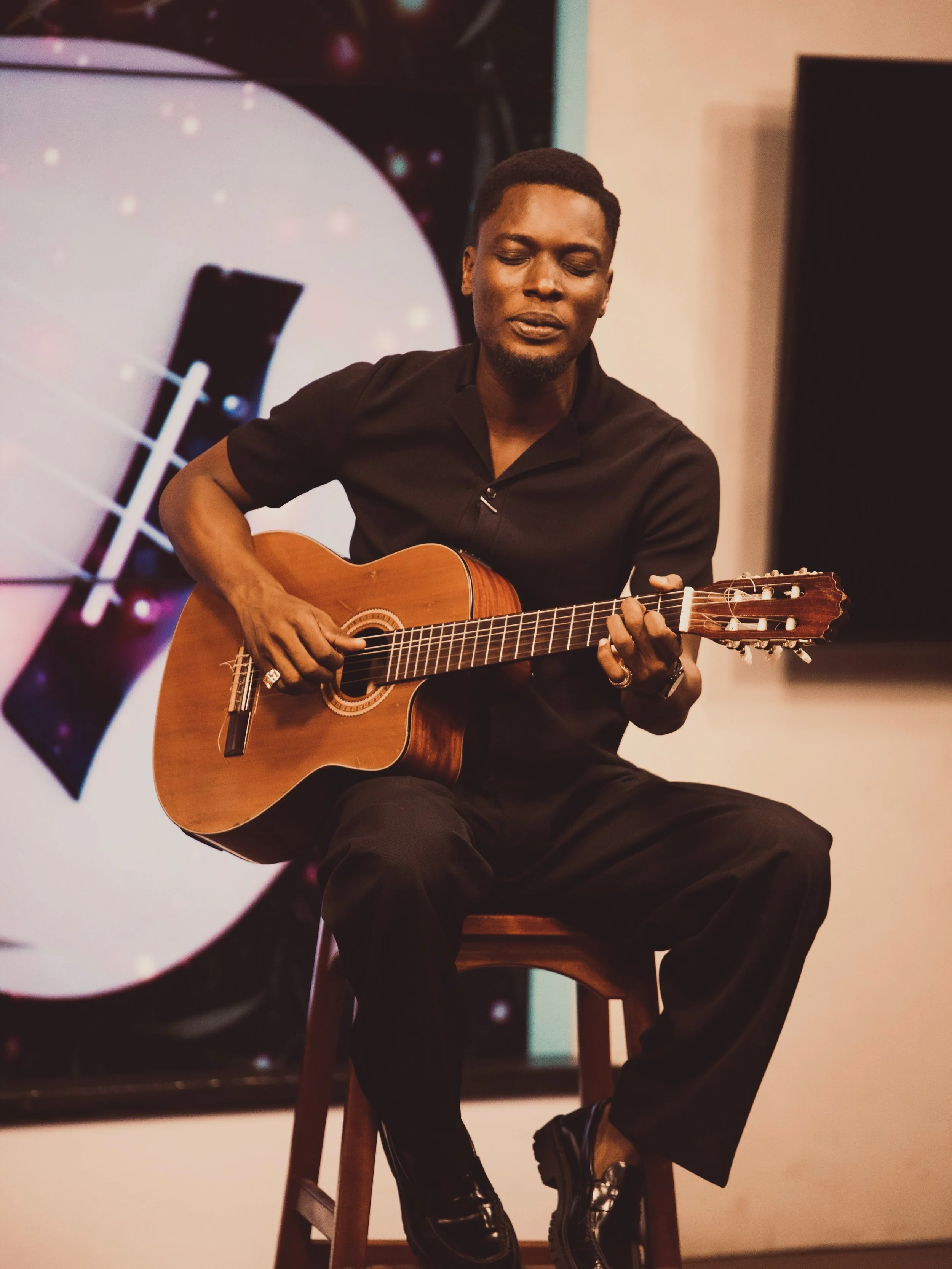
At about six in the evening, Asiama arrives at Ka xoxowo Salon and begins talking about music as though he were discussing a painting. He talks about colour, mood and atmosphere, and about the possibility of designing sound in much the same way that a painter arranges colour on a canvas. “We design music for it to transmit a certain feeling,” he says, using the sunset as an example of an experience whose power lies not simply in what one sees, but in what one feels.
Then he plays some music. Some of it is unreleased, and on one particular record there appear to be three names at work: Akwaaba, Asiamah and Yaw, different expressions within the musical personality he is constructing. He hums along as the record plays, occasionally explaining a decision or describing the atmosphere he wants the listener to enter.
This is perhaps the most useful place from which to understand Emmanuel Asiamah Mensah, known professionally as Asiama. Born in 2000, he belongs to a generation of Ghanaian musicians for whom the borders between musical traditions have become increasingly porous. Yet what distinguishes his conversation is not an eagerness to list influences or genres, but his persistent attempt to explain music as an experience.
“Imagine going to a jazz club,” he says. For Asiama, a record should have some of the quality of entering such a room: the light, the people, the instruments and the mood should somehow become part of a single experience. Music should place the listener somewhere, and the successful record should alter the emotional temperature of the room.
This is why Asiama talks about music in visual terms. At different points in our conversation, it becomes a painting, a film and an atmosphere. He believes that listening to a complete album allows the listener to digest the entire vision of an artist in much the same way that watching a film from beginning to end reveals an idea that cannot necessarily be understood from a single scene.
There is something increasingly unfashionable about this belief. Streaming has fragmented the album, allowing individual songs to circulate without the works that precede or follow them. The contemporary listener frequently encounters music through playlists, short videos and algorithmic recommendations, but Asiama remains interested in the architecture of a complete body of work.
His own musical architecture begins at home. His father is a high-ranking religious leader in the Seventh-day Adventist Church, and Asiama grew up in an environment where religion provided a powerful structure for everyday life. Home was strict, school was strict and church was strict, but somewhere within all that discipline, music offered the young boy a peculiar kind of freedom.
The contradiction is important. The church that imposed boundaries upon his childhood also gave him some of his earliest musical tools. Adventist musical culture, with its strong emphasis on singing, harmony, choirs and a cappella traditions, trained his ear long before there was any professional career to consider.
His father listened to musicians including Great Ampong and Mark Anim-Yirenkyi, and the young Asiama absorbed the sound of gospel music in the home. He remembers the particular importance of vocal harmony, an influence that remains useful in understanding the musician he would eventually become. Before he encountered the wider possibilities of popular music, the human voice had already become an instrument of enormous complexity to him.
Between roughly the ages of five and nine, music became an increasingly important part of his childhood. He joined a church brass band and continued exploring the possibilities of sound within an otherwise carefully regulated environment. If childhood elsewhere seemed governed by instructions, music allowed him to play.
The word play is central to how Asiama understands creativity. He remembers liking toys as a child, and he sees music as an extension of the same impulse: rearranging things, experimenting and discovering what happens when one object or sound is placed beside another. Music, in this sense, is serious precisely because the artist must retain enough freedom to play with it.
At Adventist Senior High School in Bantama, that instinct began to acquire formal structure. He studied music and encountered teachers who helped him recognise that what he regarded as fascination might also become vocation. One of those teachers was Yesumo, while another formative figure was Asiamah, an Adventist composer with his own choir who, on first encountering the young musician, told him that he had recognised a talent.
By then, Asiama had already begun testing that talent outside the classroom. At twelve, he had gone for X Factor, an early indication that the desire to perform was not a passing childhood interest. Looking back, he describes himself as someone who has been chasing music for virtually his entire life.
The important word is chasing. Asiama is not simply chasing fame, streams or the possibility of celebrity, although no professional musician can remain indifferent to commercial success. What he repeatedly returns to instead is what he calls the greatest high that music can give a person, the almost inexplicable emotional condition produced when sound reaches exactly where it is supposed to reach.
He wants to make music that produces that feeling. The difficulty, of course, is that feelings cannot be manufactured as easily as products, and this may explain some of his perfectionism. Asiama has created considerably more music than he has allowed the public to hear, and his reluctance to release everything he makes suggests an artist still measuring the distance between the sound in his imagination and the sound emerging from the speakers.
In the modern music business, this can be a dangerous habit. Artists are encouraged to remain permanently visible, feeding streaming platforms and social media with a constant succession of singles, videos and fragments of their lives. Asiama appears to resist that pressure because he remains unusually concerned with whether the work itself has reached the standard he wants.
There is risk in such perfectionism, because an artist can spend so long waiting for the perfect record that nothing is ever finished. Yet there is also something admirable about a young musician who believes that music should possess value beyond its immediate performance on a chart. Asiama compares music to owning a piece of land: properly understood, its value can increase with time.
The comparison reveals something important about his attitude towards art. A song is not merely a product to be consumed during the few weeks surrounding its release; it can become an asset within culture, acquiring new associations as audiences and circumstances change. The greatest records often outlive the commercial environments in which they were originally produced.
Asiama’s professional relationship with Kwame Yeboah therefore makes particular sense. Yeboah is one of Ghana’s most accomplished multi-instrumentalists, producers and musical directors, with a career extending across Ghanaian and international music. For a young artist interested in musicianship rather than merely visibility, working with Yeboah offers something increasingly valuable in the contemporary industry: apprenticeship.
Asiama describes himself as a newborn in the particular field he is trying to enter. The phrase is striking because his musical education already extends across church, school, university and professional recording. Yet he appears to understand that technical ability and artistic maturity are not the same thing, and that the latter requires time.
He is, in effect, understudying a master. There is a reason, he believes, that someone such as Kwame Yeboah would choose to work with him, and he does not interpret that relationship principally through fame. He believes it is because Yeboah can recognise that he is serious about the quality of the music.
His management also matters to this development. There is a maturity in the way Asiama speaks about allowing the people around him to perform their roles rather than attempting to control every part of the professional machinery himself. “Let the team do their part,” he says, expressing an understanding that the artist’s responsibility is not necessarily to become his own manager, publicist, strategist and accountant at once.
This division of labour allows him to concentrate on what he considers valuable: the art itself. His career is still remarkably young, with only a small number of officially released records, yet his debut Akoma has already earned significant recognition. The song won Best Male Vocal Performance at the 2026 Telecel Ghana Music Awards, placing considerable attention on an artist whose public catalogue remains relatively small.
Akoma is useful for understanding him because it is a vulnerable record. Asiama says he had to put aside his ego to make it, allowing himself to communicate emotional weakness rather than performing invulnerability. That decision carries particular significance within a culture in which masculinity can still be associated with emotional concealment.
The Ghanaian boy learns early that there are forms of softness he should conceal. Strength is frequently performed through silence, emotional distance and the ability to absorb pain without admitting that one has been wounded. Akoma pushes against this expectation because Asiama was willing to document what he describes simply as his truth at that particular moment.
The record is therefore not important merely because it demonstrates vocal ability. Its emotional architecture matters just as much as its technical execution. Asiama’s voice becomes the means through which vulnerability is given shape, making the record consistent with his wider belief that music exists to transmit feeling.
This belief also explains his fascination with frequency. “The purpose of music is to shift your frequency,” he says, arguing that different kinds of music produce different emotional and even spiritual conditions. Gospel creates one atmosphere, another genre creates another, and the extraordinary power of the musician lies in the ability to manipulate sound deliberately enough to affect the listener.
He points to the physical properties of sound as evidence of its power. Certain frequencies, he notes, can break glass, demonstrating that sound is not merely an abstract cultural object but a physical force capable of acting upon matter. To possess some understanding of how sound can be manipulated is, for Asiama, to possess an extraordinary artistic instrument.
This is where his musical thinking begins to intersect with his ideas about religion and history. Asiama believes sound has always been connected to power, and he makes a provocative observation about the colonial encounter: “There’s a reason why when they came to colonise us they did not just give us the word, but they also gave us a sound.” Christianity arrived not only with scripture and doctrine, in his reading, but with hymns, musical systems and new ideas about which sounds belonged within respectable worship.
The observation becomes more interesting when placed beside his own upbringing. Asiama was raised within a Christian musical tradition that gave him harmony, discipline and technical foundations, while simultaneously separating certain forms of music into acceptable and unacceptable categories. His subsequent career can therefore be read partly as an argument with the very institution that helped make him a musician.
This is not a straightforward rejection of Christianity. Asiama still performs in church, and spiritual language remains central to how he understands music. What he rejects is the proposition that spirituality must confine artistic expression within a predetermined musical category.
His father remains of the opinion that he should make gospel music. For a son raised in the household of a senior Adventist figure, choosing secular music therefore carries a significance that would not exist for every young Ghanaian artist. Asiama has not merely selected a genre; he has departed from an expectation embedded within the family tradition.
Yet departure does not necessarily mean abandonment. He continues to carry the harmonic education of the church into the music he now makes, just as he continues to think about sound in explicitly spiritual terms. His artistic identity is consequently built not by erasing his upbringing, but by rearranging its materials.
This is also visible in the music he encountered as he grew older. His father had restricted the secular artists he could listen to, but eventually Nicki Minaj, Lil Wayne, John Legend and Kanye West entered his musical imagination. He was attracted not simply to the sound, but to storytelling, personality and, in Kanye's case, the construction of striking visual worlds around music.
These influences did not replace the church. They complicated it. The vocal harmony of Adventist a cappella music could now exist inside the same imagination as hip-hop, contemporary R&B and the theatrical possibilities of global popular culture.
The resulting artist does not fit comfortably inside a single box, and Asiama seems determined to keep it that way. This becomes particularly clear when the conversation turns towards Highlife and the increasingly familiar Ghanaian demand that the genre should be “brought back”. Asiama does not believe bringing Highlife back is the correct ambition.
He believes it should be reinvented. Highlife, in his view, must respond to what is happening now and to the future Ghanaian musicians wish to create, rather than functioning simply as an exercise in recovering an earlier sound. He consequently refuses to define himself strictly within the boundaries of Highlife, even while recognising the tradition from which contemporary Ghanaian music emerges.
This is a culturally important distinction. Traditions do not remain alive because younger generations reproduce them perfectly; they remain alive because each generation discovers what can still be done with them. Highlife itself emerged through movement, encounter, technology and experimentation, and treating it as an untouchable historical object would contradict the restless process through which it developed.
The argument extends beyond music. Ghanaian culture frequently struggles between preservation and invention, as though respecting an inheritance requires us to reproduce it exactly. But the most durable traditions survive because people are permitted to argue with them.
Asiama is arguing with his inheritance everywhere one looks. He argues with the religious boundaries of his childhood without discarding spirituality, with the historical authority of Highlife without dismissing its importance, and with the commercial speed of contemporary music without pretending that the market does not matter. His artistic identity is emerging from these tensions.
His critique of religion goes further. He worries that Africans have acquired too many reasons not to recognise one another, particularly when religious identity becomes a boundary between people who otherwise share history, geography and cultural experience. “Why should I see my brother and not see myself?” he asks.
For Asiama, Christianity's relationship with colonialism and slavery also demands serious reflection. He believes there are things learnt within church culture that can encourage people to judge others too quickly, identifying a single perceived wrongdoing and using it as sufficient reason to condemn the whole person. “Because you identify one bad thing, you cast the stone,” he says.
His criticism is ultimately directed at judgement rather than faith. He believes everyone deserves a chance, and argues that if Ghana is going to change, some of that transformation must begin within the church. The Christian message, in his view, has too often become focused on policing behaviour rather than confronting the substance of how people actually treat one another.
This position helps explain why he refuses the gospel label while continuing to perform in church. Asiama wants the freedom to express himself fully rather than existing behind somebody else’s definition of what a religious musician ought to be. The same instinct appears repeatedly across his life: where institutions construct patterns, he looks for the space between them.
It is tempting to call this rebellion, but freedom may be the better word. His childhood contained rules at home, rules at school and rules at church, while music offered a space in which curiosity did not immediately require permission. The child who liked toys discovered another object with which he could play, except this one was limitless.
That freedom remains central to the adult artist. Asiama wants to create between one and five songs every day, not because every one of them must become a commercial release, but because making music is itself part of the process through which he thinks. Quantity at the point of creation can coexist with extreme selectivity at the point of release.
His longer-term ambition extends beyond his own voice. He would like eventually to help other artists identify and construct their own sounds, moving from performer towards the broader role of sonic architect. In this respect, he mentions figures such as Richie Mensah, whose influence on Ghanaian popular music extends beyond personal performance into production and artist development.
To shape the sound of an era is a more serious ambition than simply becoming famous within it. Fame belongs to the individual, but a sound becomes part of collective memory. When generations later remember a musical period, they remember not only names but drums, harmonies, production techniques, clothes, language, videos and the particular emotional atmosphere through which that generation understood itself.
At twenty-six, Asiama is much too early in his career for us to know whether he will accomplish this. Three released songs, an important award and distinguished mentorship are evidence of possibility rather than proof of permanence. The interesting fact at present is that he appears already to be thinking about music at the scale required to ask the question.
Perhaps this is why the evening at Ka xoxowo Salon is revealing. Asiama does not spend most of it discussing celebrity, chart positions or the mechanics of becoming famous. He talks instead about paintings, films, frequencies, spirituality, colonialism, vulnerability, Highlife and the peculiar ability of organised sound to change what a human being feels.
The unreleased records continue to play as evening settles around the Salon. Asiama hums along, sometimes explaining and sometimes simply listening, still measuring the distance between what he hears and what he wants the listener eventually to hear. Somewhere inside that process are Akwaaba, Asiamah and Yaw, and perhaps several other versions of the artist that the public has not yet encountered.
He is still chasing the feeling, and perhaps that chase is the most coherent description of his practice at this stage. The perfectionist's difficulty is that the final record may never sound exactly like the record inside his head, but the artist's privilege is that the distance between those two things provides a reason to make another tomorrow. Asiama appears willing to live inside that distance for now.
The larger question is whether he can translate this philosophy into a body of work. Ghanaian music does not lack talented singers, gifted producers or ambitious young performers; what is rarer is the sustained construction of an artistic language recognisable across albums and years. If Asiama wishes to shape the sound of an era, the task ahead is not merely to make excellent songs, but to create a musical vocabulary that could unmistakably belong to him.
For now, there is something compelling about watching the attempt begin. A young man raised within strict boundaries has chosen an art form in which his principal desire is freedom, while the very church whose restrictions he questions gave him the harmonic foundations upon which that freedom is built. That contradiction is not an inconvenience in the Asiama story; it may ultimately be the source of its most interesting music.
At Ka xoxowo Salon, he presses play again. The music fills the room, and the cultural arguments temporarily become unnecessary because sound is finally allowed to make its own case. Like the sunset Asiama described when he arrived, the point is not simply to observe it, but to feel something change.