
Denyse Gawu-Mensah and the Art of Remembering Ghana

V. L. K. Djokoto
Photos via Gallery 1957
Every society decides what it remembers. Sometimes the decision is deliberate: governments build monuments, historians write books and institutions preserve official records. But much of a nation’s real history survives somewhere less formal — in family albums, old furniture, clothes, photographs, music, letters and the ordinary objects people leave behind.
The work of Ghanaian artist Denyse Gawu-Mensah begins in this less formal territory. She is interested in the things that families keep, the things they discard, and the memories that survive between the two. Her work therefore raises a deceptively simple cultural question: what happens to a society when the evidence of ordinary life disappears?
This question has become central to Gawu-Mensah’s multidisciplinary practice. A graduate of Communication Design at the Kwame Nkrumah University of Science and Technology, she works across collage, photography, textiles, installation and found material. She has described herself as a collector, gathering objects, experiences and memorabilia as she travels and turning them into material for artistic expression.
There is an important distinction to make here. Gawu-Mensah’s art is often described through the language of nostalgia, and understandably so. Old photographs, faded surfaces and memories of post-independence Ghana naturally produce nostalgia, but nostalgia alone does not adequately explain what she is doing.
Nostalgia looks backwards because the past is pleasurable. Gawu-Mensah looks backwards because the past contains evidence. Her practice is therefore closer to cultural archaeology: she retrieves fragments, examines them, rearranges them and asks what they can tell us about the people who inhabited Ghana before us.
That distinction matters because Ghana has often been documented from above. We know the photographs of presidents, independence ceremonies, military coups, state visits, parades and political rallies. They are necessary records, but a country is not made by presidents alone.
A country is also made in sitting rooms. It is made in the clothes people choose for Sunday afternoon, the chairs on which grandparents sit, the hairstyles young women adopt, the music played at parties, the photographs taken before weddings and the arrangements people make inside their homes. These seemingly minor details reveal how a society understands dignity, aspiration, beauty, class, family and modernity.
Gawu-Mensah turns precisely towards this social world.
Her most accomplished statement of that concern so far is LIGHTYEARS OF US, her inaugural solo exhibition at Gallery 1957 in Accra. Curated by Angelica Litta Modignani, the exhibition grew out of Gawu-Mensah winning the 2024 Yaa Asantewaa Art Prize. It drew extensively from a family archive of photographs from the 1960s and 1970s, transforming private photographs into material meditations on Ghana's post-independence experience.
The title itself is revealing. A lightyear measures distance rather than time, yet it necessarily contains time because light must travel before it can be seen. We therefore see distant objects not exactly as they are, but as they were when their light began travelling towards us.
The photograph performs something similar.
Every photograph is delayed light. The shutter closes, the moment disappears, people grow older and buildings change, but the image remains. When we look at an old photograph, we are receiving light from a world that no longer exists in quite the same form.
Gawu-Mensah understands this intuitively. In LIGHTYEARS OF US, photographs from the 1960s and 1970s are digitally worked and manually transferred onto textiles. The resulting surfaces can appear distressed, imperfect and aged, allowing the material itself to carry something of the vulnerability of memory.
This is where her choice of medium becomes culturally important. She does not simply enlarge an old photograph and place it on a gallery wall. She intervenes in it.
The image passes through another material. It is transferred, layered, repeated or reorganised. The photograph ceases to function only as a document and becomes an object with a new physical life.
That process resembles memory itself. We do not inherit the past intact. We inherit fragments, stories, photographs and objects, and each generation reconstructs meaning from what remains.
One striking example is Kobla On Duty (2024). The work uses a photograph of soldiers inspecting supplies in their barracks and transfers the image onto sack linen, producing a worn surface that recalls an ageing family photograph. The military scene consequently moves between public and private history: these are soldiers, representatives of the state, but they are also men sharing the ordinary rhythms and relationships of daily life.
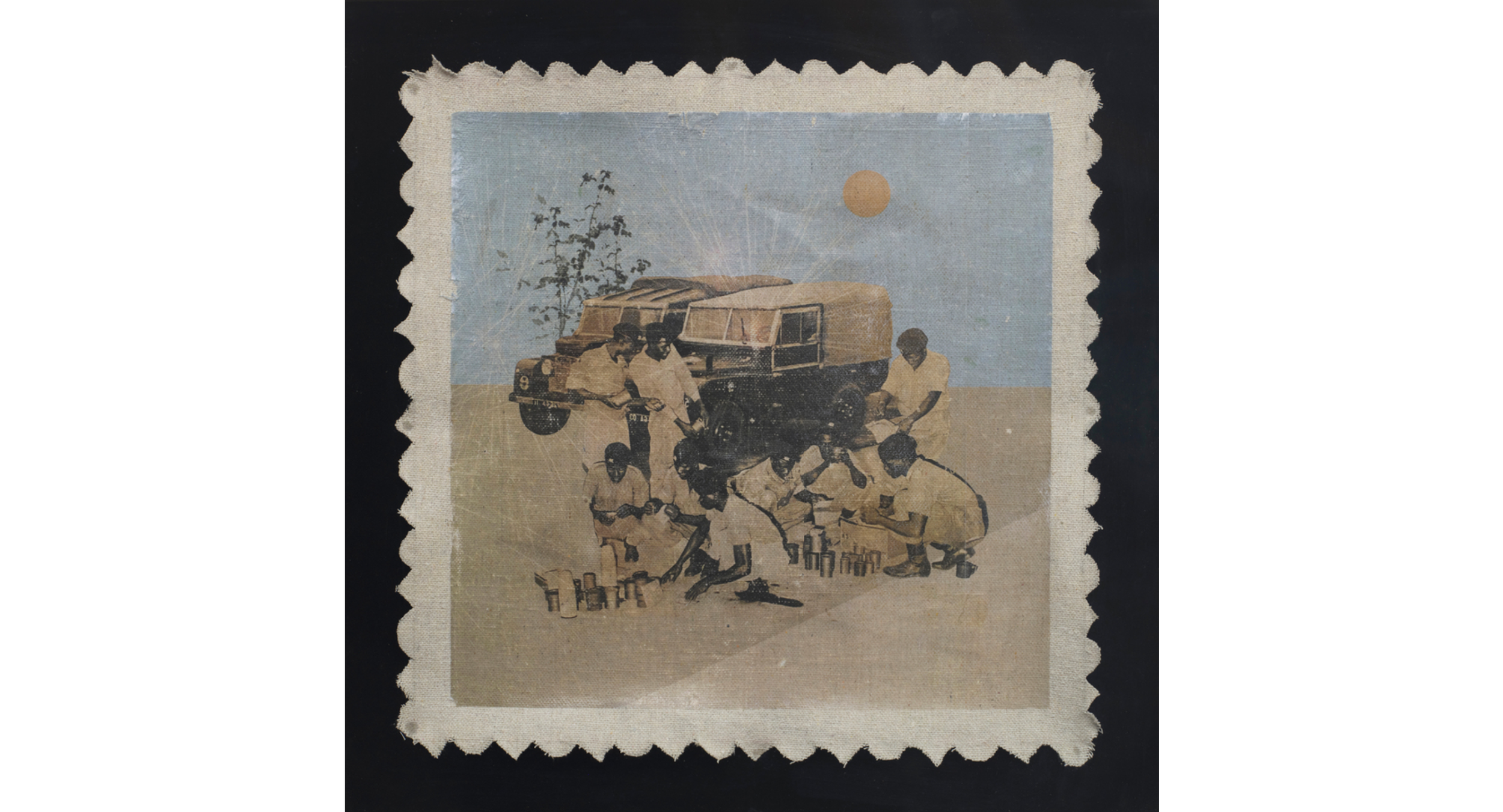
Kobla On Duty, 2024
Photo transfer on sac linen, framed
19 7/10 × 19 7/10 in | 50 × 50 cm
This tension between the national and the intimate runs through Gawu-Mensah’s work. Ghana's post-independence history is conventionally narrated through large events: 1957, republican status, industrialisation, Pan-Africanism, the 1966 coup and the political upheavals that followed. Gawu-Mensah approaches the same historical period through another door.
She asks, in effect, what independence looked like at home.
This is an important question for cultural theory because political independence was not simply a constitutional event. It also produced a new imagination of the African self. Independence concerned how Africans governed themselves, certainly, but it also concerned how they dressed, photographed themselves, built houses, made music, travelled, consumed and imagined their place in the modern world.
The studio photograph was particularly important to that process. Across post-independence Africa, photographic studios allowed ordinary people to participate in the construction of their own image. Clothes, poses, furniture and painted backgrounds became instruments through which people could announce who they were — or who they intended to become.
It is therefore significant that part of LIGHTYEARS OF US reconstructed the atmosphere of the photographic studio. Gawu-Mensah’s exhibition acknowledged the visual traditions associated with photographers including James Barnor, Samuel Fosso, Jean Depara and Sanlé Sory. The other section evoked domestic interiors familiar within Ghanaian homes, bringing the public history of post-independence modernity into conversation with the intimacy of domestic memory.
This is not historical reconstruction for its own sake. The home is an archive.
A sofa can tell us about taste. A dress can tell us about changing ideas of femininity, prosperity and cosmopolitanism. A photograph of relatives standing beside a car can reveal something about mobility, class and the aspirations of a generation.
Even the arrangement of a room can tell us how Ghanaians understood modern living.
Gawu-Mensah’s practice becomes particularly interesting when these objects are considered not as decorative remnants but as social documents. Material culture records history differently from the written archive. It tells us how historical change was actually lived.
Her use of Nsasawa makes this argument especially clear. The Ghanaian patchwork tradition — associated in Gawu-Mensah's own family with her grandmother's practice of sewing together discarded pieces of material — becomes both method and metaphor. Rather than fabric alone, Gawu-Mensah can arrange repeated photographic portraits into a visual patchwork, joining individual identities into a larger field of memory.
There is a philosophical proposition hidden inside that technique.
No culture arrives in the present as a single, complete piece. Culture is nsasawa. It is assembled.
We inherit pieces of language, ritual, fashion, architecture, music, food, family stories and political memory. Some fragments are old and some are new; some are preserved deliberately while others survive by accident. What we call Ghanaian culture is ultimately the continuous act of arranging these fragments into a meaningful whole.
Gawu-Mensah’s development as an artist also reflects the changing ecology of contemporary Ghanaian art. She has been a member of Asafo Black, the artist collective formed in 2017 by artists emerging from the Kumasi College of Art. The collective developed a practice around self-organised and guerrilla-style interventions, drawing upon influences as varied as hip-hop, nightlife, popular commodities, proverbial traditions and religious imagery.
She has since moved through increasingly international spaces. Her work has appeared with Gallery 1957 in Accra and London, and she was included in the gallery’s presentation at Frieze Seoul in 2025. This year, she is among the artists represented in GHANA! Dreaming Independence, 1957–1976 at Les Rencontres d’Arles, appearing within a historical and contemporary field that includes Felicia Abban, James Barnor, Willis E. Bell, Efua T. Sutherland and Paul Strand.

That progression is significant. It demonstrates that contemporary Ghanaian art need not become less Ghanaian in order to become internationally legible. The local archive can itself become the basis of a global artistic language.
Indeed, this may be one of the most important developments in contemporary African art. For decades, African modernity was frequently interpreted through categories constructed elsewhere. African artists were expected either to perform a recognisable idea of tradition or to demonstrate their arrival within a supposedly universal modernism.
Artists such as Gawu-Mensah complicate that division.
The family album is traditional and modern at once. The photograph is simultaneously technological and sentimental. The post-independence sitting room may contain imported furniture, locally sewn textiles, European fashions, Ghanaian music and family customs inherited across generations.
There is no contradiction here. That mixture is modern Ghana.
This also explains why Gawu-Mensah’s work should be considered beyond the immediate boundaries of the contemporary art market. Ghana has an archival problem. Too much of our twentieth-century material history remains scattered across private homes, deteriorating albums, abandoned buildings, foreign institutions and collections whose owners may not recognise their historical importance.
Every family has its archive.
The problem is that we seldom call it one.
A box of photographs beneath somebody’s bed may contain an extraordinary record of Accra in 1964. An old album in Ho may preserve a forgotten account of school life in the 1950s. A wardrobe in Cape Coast may contain textiles capable of telling us how Ghanaian taste changed across three generations.
When those objects disappear, knowledge disappears with them.
Artists can intervene in this process because art does something the conventional archive sometimes cannot. It can take an apparently ordinary photograph and force us to look again. It can restore cultural importance to an object precisely because somebody once considered it too commonplace to preserve.
This is ultimately where Gawu-Mensah’s work acquires its wider importance.
She is not arguing that the past was better than the present. Nor does her work require us to romanticise post-independence Ghana. The 1960s and 1970s contained political violence, economic difficulty and profound social contradictions alongside optimism and cultural confidence.
The point is different.
A nation requires memory because memory gives depth to identity. Without memory, culture becomes performance without context: patterns, clothes, music and slogans detached from the historical lives that gave them meaning.
Denyse Gawu-Mensah works against that flattening.
She takes the photograph out of the album and asks us to see history in it. She takes material associated with domestic life and asks us to recognise its intellectual value. She takes private memory and reveals the national story quietly contained inside it.
There is something particularly Ghanaian about this approach. Our history has always lived as much in the spoken story and family possession as in the official document. The challenge of the present generation is to ensure that these private archives do not vanish before we understand what they contain.
Gawu-Mensah offers one answer: gather the fragments.
Look closely at the old photograph. Keep the cloth. Listen to the story attached to the chair, the record, the dress or the family album.
Then make something from what remains.
For memory is not the opposite of modernity. Properly understood, memory is one of the materials from which modernity is made. And in Denyse Gawu-Mensah's work, Ghana's past is not a distant country at all; its light is still travelling towards us.