
Are Ghanaian Men Romantic?
By V. L. K. Djokoto
Are Ghanaian men romantic? This is one of those questions which appears harmless until you actually try to answer it, at which point you realise that you have wandered into territory more dangerous than a family meeting about an unapproved marriage. The evidence, I must say, is mixed: Ghanaian men are perfectly capable of romance, but many approach it with the same caution with which they approach paying for a bill they did not personally order.
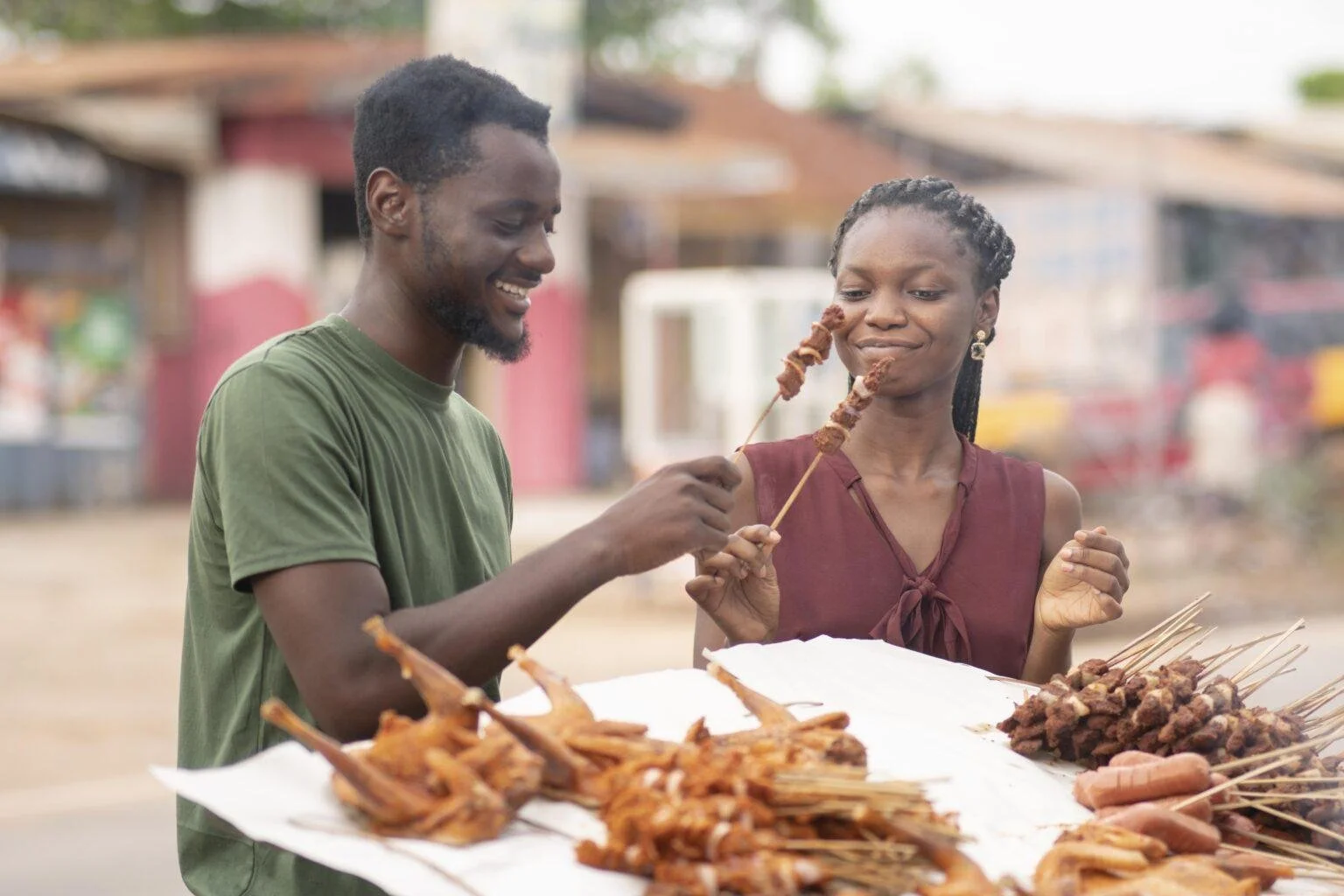
The Ghanaian man has a very particular understanding of love. He may not tell you that you are the most beautiful woman he has ever seen, but he will notice that your phone battery is at 12 per cent and quietly produce a power bank; he may not compose poetry, but he will send you MoMo at precisely the moment your account balance has become a matter of prayer. He may not say, “My darling, I have been thinking about you all day,” but at 9:36 p.m. he will send the most consequential sentence in the Ghanaian romantic lexicon: “Have you eaten?”
Let us pause here, because “Have you eaten?” deserves constitutional protection. It is not merely a question about food; it is a Swiss Army knife of Ghanaian affection. It can mean “I love you”, “I miss you”, “I am worried about you”, “I want to see you”, “I have been thinking about you”, or, in the case of a man who has exhausted every conversational possibility, “I have no idea what to say next.”
There is, of course, another form of Ghanaian romance: the grand gesture. When a Ghanaian man decides to be romantic, he can suddenly become a one-man events company, complete with restaurant reservation, flowers, perfume, photographer, customised cake and enough decoration to make you wonder whether he is proposing marriage or launching a new political party. He will spend money with the confidence of a man who has discovered oil underneath his compound, and for one glorious evening he will behave as though love itself has received funding from the Ministry of Finance.
The trouble begins the following Monday. The flowers have died, the photographer has sent the pictures, the cake has been eaten and the man has returned to his natural habitat: sitting quietly somewhere while watching football and responding to messages with “okay”. Romance, however, cannot survive exclusively on anniversaries and carefully edited photographs; it needs maintenance, rather like a Ghanaian car navigating Accra roads.
And this is where the Ghanaian man encounters his greatest romantic obstacle: communication. Ghanaian men can discuss football tactics for ninety minutes without interruption, explain why the referee was wrong, give a detailed account of why the economy is suffering and tell you precisely which politician is destroying the country, but ask them how they feel about their girlfriend and suddenly they are unavailable for comment. You might as well have asked them to explain quantum physics in Latin.
The problem is not necessarily that Ghanaian men do not feel deeply. On the contrary, many do. They simply belong to a culture in which men are often taught that vulnerability is something to be hidden behind a serious face, a pressed shirt and the occasional sentence beginning with “As a man…” The result is a generation of men who can provide, protect, organise and solve problems magnificently but sometimes struggle with the revolutionary act of saying, “I missed you.”
There is also the boys. Never underestimate the boys. A Ghanaian man can secretly write a six-paragraph love message to his girlfriend at midnight, but if one of his friends discovers it, the entire operation becomes a national comedy. His friends will ask whether he has joined a women’s empowerment group, whether somebody has bewitched him, and whether the relationship has come with a change of surname.
So the Ghanaian man learns to disguise romance as practicality. “I am passing through your area” may mean “I drove forty-five minutes because I wanted to see you.” “I bought extra” may mean “I remembered that you like this.” “I was around” may mean “I have been circling your neighbourhood like a private investigator.” And “Take care of yourself” may contain an emotional depth which the man himself would rather die than unpack.
There is something rather touching about this. Ghanaian men often love through service. They fix the thing, pay the bill, make the call, arrange the transport, send the MoMo and ask whether you have reached home. It is affection wearing overalls, and one should not mock it. But there comes a point when the woman would like the mechanic to put down the spanner and simply tell her that she is loved.
Romance, after all, is not a foreign import. Ghana has plenty of it. We have highlife, moonlit beaches, cold malt, kelewele, grilled tilapia, quiet drives, old love songs, evening conversations and the extraordinary Ghanaian ability to sit somewhere for three hours discussing absolutely everything and nothing. We do not need to import romance from Hollywood; we merely need Ghanaian men to stop behaving as though expressing affection requires parliamentary approval.
And perhaps this is the great misunderstanding. Romance is not about spending outrageous sums of money, although money certainly has a remarkable talent for improving one’s chances in this department. It is about attention: remembering her favourite song, noticing that she is unusually quiet, calling when you promised to call, sending the message before she has to ask and occasionally saying something so embarrassingly sincere that your friends would have to be physically removed from the room before you could say it.
So, are Ghanaian men romantic? Absolutely. They are just romantically bureaucratic. There are forms to be completed, emotions to be reviewed, applications to be submitted and, in some cases, a three-year probation period before the gentleman admits that he is actually in love.
But there is hope. The modern Ghanaian man is beginning to discover that being romantic does not make him less of a man; it merely makes him a man who knows what he is doing. He can still be strong, ambitious, protective and responsible while also saying, “You look beautiful today,” without collapsing into the Atlantic Ocean.
So gentlemen, here is the national assignment. Call her. Compliment her. Buy the flowers before she complains. Remember the small things. Tell her you missed her without first pretending that you happened to be passing through the area.
And by all means ask, “Have you eaten?”
Just make sure it is not an empty question.
Because if you ask a Ghanaian woman whether she has eaten and then proceed to do absolutely nothing about it, you have not demonstrated romance.
You have merely conducted a survey.