
V. L. K. Djokoto
There are buildings whose importance extends far beyond their architectural beauty. They preserve the memory of societies, reflect the ambitions of governments and reveal how nations understand themselves. In Lomé, the capital of Togo, one such building has acquired a new cultural significance. The Palais de Lomé, once a residence of colonial governors, has become one of West Africa’s most compelling examples of cultural renewal.
Its significance lies not merely in the restoration of an old palace. Rather, it lies in the transformation of a former seat of political authority into a public institution devoted to art, history and the natural environment. This change presents an important argument about culture and power. A building constructed to represent foreign authority can, through a deliberate change of purpose, become an instrument of national expression.
The Palais de Lomé is therefore more than an architectural landmark. It represents a wider movement towards the preservation and reinterpretation of African heritage. Its development also raises an important question for modern African societies: how can inherited institutions and historical buildings serve the cultural needs of present and future generations?
The Architecture of Power
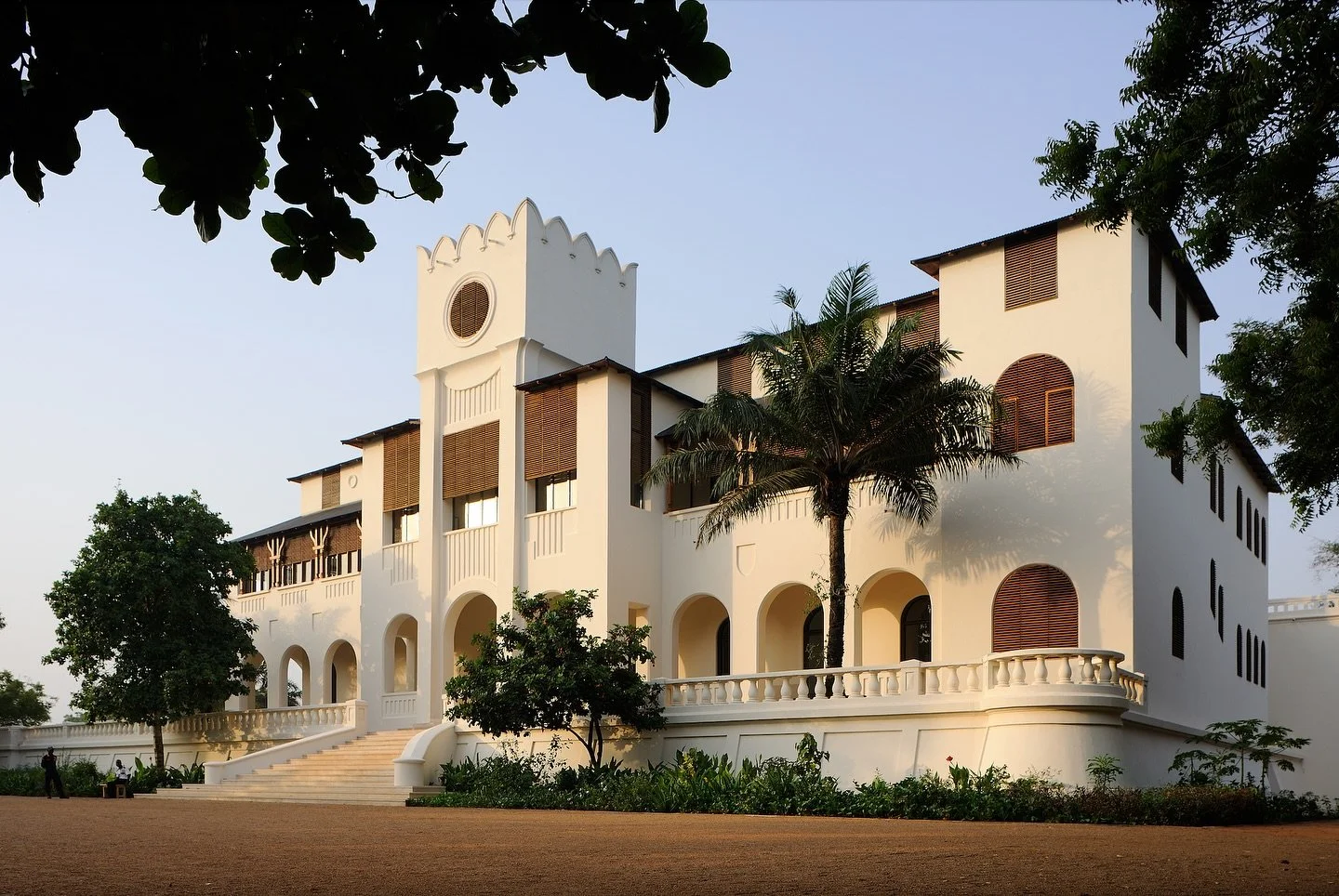
The history of the Palais de Lomé begins in the colonial period. Constructed between 1898 and 1905, the palace was originally intended as the residence of German colonial governors. Its position near the Atlantic coast was deliberate. The building was designed to make colonial authority visible, even from the sea.
Architecture has always been closely associated with political power. Governments construct monumental buildings not simply to accommodate officials, but to communicate authority, permanence and prestige. The Palais de Lomé belonged to this tradition. Its imposing structure, grand staircases, open galleries and carefully organised grounds expressed the confidence of a colonial administration.
Following the First World War, the building passed into French colonial use. After Togo gained independence in 1960, it became part of the country's presidential establishment, before serving other official purposes. These changes demonstrate how the meaning of a building can evolve alongside the political institutions that occupy it. Yet the palace remained associated with government and restricted access.
Political unrest in the early 1990s contributed to its decline. For more than two decades, the building remained largely abandoned, gradually losing its architectural dignity. Its deterioration reflected a familiar problem across Africa, where important historical buildings are often left without a clear public purpose. In such circumstances, the loss is not only architectural. Society also risks losing a physical record of its political and cultural history.
From Political Authority to Cultural Expression
The restoration of the Palais de Lomé, culminating in its reopening as an art and culture centre in November 2019, marked a significant departure from its original purpose. The Togolese state supported the project, while its founding director, Sonia Lawson, played a central role in shaping its cultural vision. The result was an institution intended to bring together artistic production, historical preservation and public education.
The importance of this transformation deserves careful consideration. For much of its history, the palace represented authority exercised over society. Its new purpose allows society to enter, observe, question and participate. The building has not lost its history, but its relationship with the public has changed.
There is a distinction between preserving a historical building and giving it renewed social meaning. Preservation protects the physical structure, while cultural renewal establishes a relationship between the structure and contemporary society. The Palais de Lomé has attempted both. It has retained important features of its architecture while introducing new spaces for exhibitions and cultural activities.
This approach offers a useful lesson in the treatment of colonial heritage. The destruction of every colonial monument would remove important evidence of the past. Equally, preserving such monuments without examining their history would leave their original meanings largely undisturbed. A more constructive approach is to preserve the architecture while changing its social function and encouraging a critical understanding of its origins.
The Palais de Lomé illustrates this possibility. What was once a building intended to demonstrate colonial power now provides a setting for African creativity. The importance of that reversal should not be underestimated.
A New Home for African Cultural Thought
The modern Palais de Lomé occupies an important position within West Africa's developing cultural landscape. Its exhibitions extend across painting, sculpture, photography, design and other creative disciplines. It also creates opportunities to examine the relationship between traditional artistic knowledge and contemporary expression.
This broader understanding of culture is essential. African artistic traditions cannot be adequately understood through the narrow separation of fine art, craft and everyday life. Textiles, ceremonial objects, furniture, architecture and decorative practices have long carried important social meanings. They express ideas about authority, spirituality, community and identity.
The institution's early exhibitions demonstrated this breadth. Displays examining the history of Togolese kingdoms appeared alongside presentations of contemporary creative work, including the legacy of designer Kossi Aguessy. The arrangement suggested that historical heritage and modern artistic practice should not be treated as separate cultural worlds. Each offers a way of understanding the other.
An important example emerged in 2026 with the exhibition Design in West Africa: Unity in Multiplicity. Bringing together more than twenty artists and designers from across the region, the exhibition explored the relationship between shared cultural traditions and individual creative expression. Its participants worked with materials and ideas ranging from wood and ceramics to textiles, metal and contemporary furniture. The exhibition made an important point: West African design cannot be reduced to a single style or national tradition.
Such exhibitions perform a function beyond the display of beautiful objects. They create intellectual connections between artists, designers, historians and audiences. They also place African creative work within an African institutional setting. This is especially important in a world where international recognition has often depended on exhibitions, museums and commercial galleries outside the continent.
For generations, African art has been interpreted through institutions established in Europe and North America. These institutions have contributed to scholarship and international recognition, but they have also exercised considerable influence over how African artistic traditions are classified and valued. The emergence of strong cultural institutions within Africa creates opportunities for a more balanced relationship. It allows African societies to participate more directly in the interpretation of their own cultural production.
The Palais de Lomé belongs to this movement. Its importance is not that it rejects international cultural exchange. Rather, it demonstrates that meaningful cultural exchange requires institutions capable of speaking from their own historical and geographical positions.
Culture, Nature and the Modern City
One of the Palais de Lomé's most distinctive features is its relationship with the natural environment. The restored building stands within an eleven-hectare park extending towards the Atlantic coast. Its grounds contain mature tropical trees, varied plant life and spaces for outdoor sculpture and public discovery. This environment distinguishes the institution from the conventional urban art gallery.
The relationship between culture and nature is particularly important in the African context. Before the establishment of modern museums, many communities experienced artistic expression through public spaces, festivals, ceremonies and communal gatherings. Cultural life was not always confined to buildings. It was part of the wider social and natural environment.
The Palais de Lomé offers an opportunity to recover something of this relationship in a contemporary setting. Visitors encounter not only works displayed within galleries, but also vegetation, landscape and artistic installations across the grounds. The experience encourages a broader understanding of cultural heritage. It suggests that the environment in which a society lives is itself part of its collective inheritance.
There is also an important urban argument. As African cities expand, public green spaces face increasing pressure from commercial development. Land near city centres and coastlines is especially vulnerable because of its economic value. The decision to preserve a substantial part of Lomé's waterfront as a cultural and environmental space therefore has civic significance.
A modern city should not be judged entirely by the height of its buildings or the scale of its commercial activity. Its development must also be measured by the quality of the spaces available for public life. Parks, libraries, museums and cultural centres provide opportunities for education, recreation and social interaction. They are not secondary institutions. They form part of the infrastructure of a civilised society.
The Cultural Economy
The economic value of cultural institutions is often underestimated in African development policy. Governments generally prioritise roads, energy, agriculture and industrial production, while art and heritage are frequently treated as discretionary expenditure. Yet culture can support employment, tourism, education and the growth of creative industries. Its value is both economic and social.
The Palais de Lomé demonstrates how investment in heritage can create new forms of economic activity. A restored historical site can attract visitors, support artistic production and generate demand for professional services. Curators, conservators, architects, designers, photographers, researchers and cultural administrators all contribute to the operation of such institutions. The benefits may extend into hospitality, transport and other local services.
However, the success of a cultural institution should not be measured by visitor numbers alone. A museum may attract tourists while remaining largely irrelevant to the people who live around it. A more meaningful assessment would consider its contribution to education, artistic development and public understanding. The central question is whether the institution strengthens the cultural life of the society it serves.
This distinction is important for the Palais de Lomé. Its long-term value will depend on its ability to remain a serious cultural institution rather than simply an attractive destination. Exhibitions must be accompanied by research, educational programmes and sustained engagement with artists. Its public character must be reflected in practical opportunities for ordinary citizens to participate.
Cultural Sovereignty and Public Memory
Perhaps the most interesting aspect of the Palais de Lomé is the question of cultural sovereignty. Political independence gives a nation legal authority over its territory and institutions. Cultural sovereignty concerns its ability to preserve, interpret and develop its own historical experience. The two are related, but they are not identical.
A country may govern itself politically while remaining dependent on foreign institutions for the preservation and international interpretation of its cultural heritage. It may produce important artists without possessing the museums, collections and research institutions required to support their work. This imbalance limits the development of a confident national cultural life. Cultural independence therefore requires institutional investment as well as artistic talent.
The Palais de Lomé offers one response to this problem. Its transformation demonstrates that historical architecture can be used to support contemporary African cultural production. It also provides a setting in which African artists and audiences can examine their relationships with history, identity and modernity. In this sense, the institution contributes to the wider development of cultural sovereignty.
Nevertheless, ownership of a building does not automatically guarantee intellectual independence. A serious cultural institution must have room to examine difficult historical questions and present different interpretations of the past. This is particularly relevant to a palace whose history includes colonial administration, presidential authority and political unrest. Its credibility will depend partly on its willingness to engage with those histories.
The palace should therefore be understood neither as a rejection of the past nor as a celebration of every period it has witnessed. Its proper function is to make that past available for public understanding. Historical memory becomes valuable when it encourages reflection rather than demands unquestioning admiration.
The Making of a Cultural Icon
What, then, makes the Palais de Lomé a modern cultural icon? Architectural beauty alone is insufficient. A building becomes culturally significant when its physical presence acquires a meaning shared beyond the intentions of its original builders. It must come to represent something important in the life of a society.
The Palais de Lomé has begun to acquire such a meaning because its new purpose represents a clear change in values. A former symbol of restricted political authority has become a place for public cultural expression. A neglected colonial monument has been restored without being stripped of its historical identity. A valuable urban landscape has been preserved for cultural and environmental use.
These achievements are substantial, but they must be sustained. The institution's future will depend on the quality of its exhibitions, the development of professional expertise and the strength of its relationships with artists and local communities. Its significance must also reach beyond Lomé, contributing to cultural exchange across Togo and the wider region. A cultural icon remains relevant only when society continues to find value in it.
There is a broader lesson here for African governments and cultural institutions. Heritage should not be regarded merely as an inheritance to be admired. It is also a resource that can be adapted to meet contemporary needs. The preservation of historical buildings becomes most meaningful when it supports education, public life and cultural creativity.
West Africa possesses an extraordinary architectural inheritance, including royal compounds, colonial buildings, traditional settlements and modernist structures from the independence period. Many of these sites require preservation, while others need imaginative new purposes. The Palais de Lomé provides an example of what can be achieved when historical conservation is connected to a serious institutional vision. It suggests that cultural development need not begin with the construction of entirely new monuments.
A Palace for the Future
The significance of the Palais de Lomé ultimately rests on a simple proposition: the meaning of a historical building need not remain fixed. Architecture may preserve the intentions of those who built it, but subsequent generations possess the capacity to give it a different purpose. The past cannot be changed, but its place within contemporary society can be reconsidered.
In its present form, the Palais de Lomé stands at the meeting point of history, artistic production and public life. Its galleries encourage cultural interpretation, while its grounds demonstrate the value of preserving nature within a growing city. Together, these elements present a thoughtful model of how heritage can contribute to modern development.
For Togo, the palace offers an institution through which national culture can be preserved, examined and presented to wider audiences. For West Africa, it provides a valuable example of how public investment can strengthen the region's cultural infrastructure. For the wider continent, it raises a question that extends far beyond Lomé: what should African societies do with the buildings, institutions and historical spaces they have inherited?
The answer cannot be found in restoration alone. It lies in the purposes to which these places are put, the people they serve and the ideas they make possible. The Palais de Lomé has become a modern cultural icon because it demonstrates that a monument's greatest value may emerge long after its original political purpose has disappeared.
Its most important achievement is not that an old palace has been made beautiful again. It is that a place once associated with the exercise of power has been given a new purpose in the cultural life of the people.
That is the true measure of its renewal.